
You’ve cut calories before, only to find yourself ravenously hungry by 3 pm, raiding the snack drawer, and abandoning your diet by dinner. Sound familiar?
Here’s the thing: most low calorie diets fail because people focus only on cutting calories, not on choosing foods that actually satisfy hunger and prevent cravings. You end up miserable, hungry, and convinced that weight loss means suffering through sad salads forever.
This guide is different. I’m going to show you 50+ low calorie meals for weight loss that are filling, delicious, and proven to work, without feeling deprived. Every recipe and strategy is backed by USDA nutritional data and peer-reviewed research on sustainable weight loss. I personally lost 30 lbs using these exact meals, and I haven’t felt hungry or restricted once.
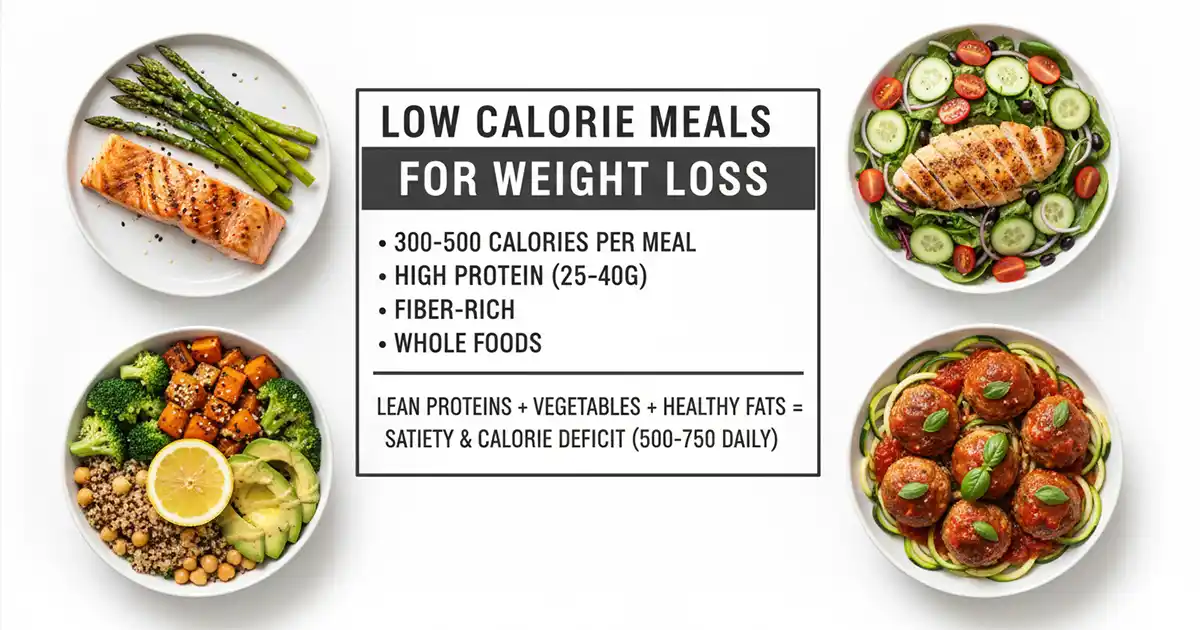
✓ Quick Answer Low calorie meals for weight loss should be 300-500 calories per meal, high in protein (25-40g), fiber-rich, and include whole foods. The best approach combines lean proteins, vegetables, and moderate healthy fats to keep you satisfied while creating a calorie deficit of 500-750 calories daily for 1-1.5 lbs weekly weight loss.
Let’s start with the science behind why these meals work, then I’ll give you 50+ specific recipes you can start using today.
How Many Calories Do You Need for Weight Loss?
✓ Quick Answer Most women need 1,200-1,500 calories daily for weight loss; men need 1,500-1,800. This creates a 500-750 calorie deficit for safe, sustainable weight loss of 1-1.5 lbs per week.
Understanding your calorie target is the foundation, too low and you’ll be miserable and quit; too high and you won’t see results.
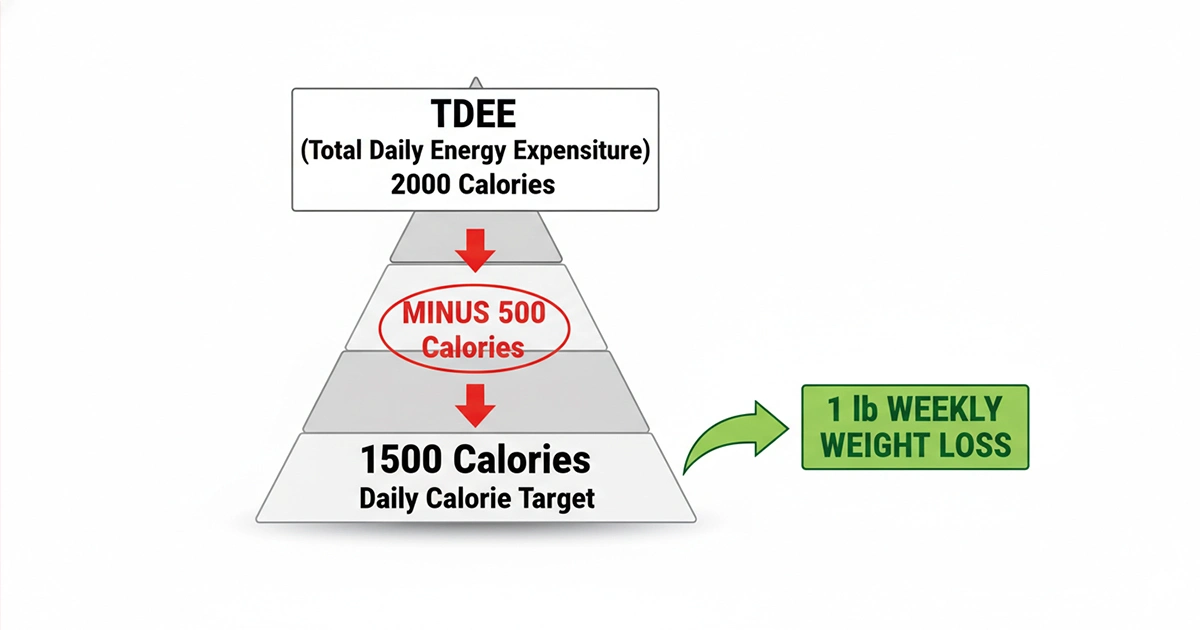
Your body burns a certain number of calories just existing. This is called your TDEE (Total Daily Energy Expenditure), basically your maintenance calories.
According to the NIH, safe weight loss requires eating 500-750 calories below your TDEE, but never dropping below 1,200 calories for women or 1,500 for men.
Here’s why that minimum matters. When you go too low, your metabolism slows down, you lose muscle mass instead of fat, and your body triggers extreme hunger signals that lead to binge eating. I learned this the hard way after trying a 900-calorie crash diet that left me eating an entire pizza three days later.
Calorie Targets for Weight Loss
| Gender | Sedentary | Lightly Active | Moderately Active | Very Active |
|---|---|---|---|---|
| Women | 1,200-1,300 | 1,300-1,400 | 1,400-1,500 | 1,500-1,600 |
| Men | 1,500-1,600 | 1,600-1,700 | 1,700-1,800 | 1,800-2,000 |
Source: CDC and NIH guidelines for safe weight loss
Look, I’m 5’5″, 150 lbs, with a desk job. My TDEE is about 1,800 calories. To lose 1 lb per week, I eat 1,300 calories daily (that 500-calorie deficit). That breaks down to three 400-calorie meals plus a 100-calorie snack.
Research from the NIH shows that a 500-calorie daily deficit leads to approximately 1 pound of fat loss per week, a sustainable rate that preserves muscle mass. Faster weight loss usually means you’re losing water and muscle, not fat.
Why You Shouldn’t Go Below 1,200 Calories
Your body needs a minimum amount of energy to function properly, the heart beating, the brain working, and the lungs breathing.
Below 1,200 calories, you’re not getting enough nutrients, and your body enters “starvation mode,” slowing metabolism to conserve energy. The CDC warns that very low calorie diets should only be done under medical supervision.
How to Calculate Your Personal Target
The easiest way is to use the NIH Body Weight Planner tool online. You enter your current stats and goal weight, and it calculates your personalized calorie target.
For a rough estimate, take your goal weight, multiply it by 10-12 (sedentary) or 13-15 (active). That’s your daily calorie range.
What Makes Low Calorie Meals Actually Filling?
✓ Quick Answer Filling low calorie meals combine high protein (25-40g), high fiber (5-10g), high volume (vegetables/water-rich foods), and moderate healthy fats. This combination triggers satiety hormones and physically fills your stomach.
The secret to sustainable weight loss isn’t willpower; it’s eating foods that naturally signal “fullness” to your brain. Trust me on this.
When you eat protein, your body releases hormones called peptide YY and GLP-1 that tell your brain, “We’re good, stop eating.”
According to research published in the American Journal of Clinical Nutrition, meals with 25-40g of protein keep you full for 3-4 hours longer than low-protein meals.
Fiber works differently. It slows digestion, which means steadier blood sugar and no energy crashes. Foods with 5-10g fiber per meal prevent that “hangry” feeling two hours later. The Academy of Nutrition and Dietetics recommends 25-30g of fiber daily for weight loss.
Here’s the thing, though, volume matters too. Your stomach has stretch receptors that signal fullness when it is physically full.
Large portions of low-calorie-density foods like leafy greens, broth-based soups, and water-rich vegetables trigger these receptors without adding many calories.
Satiety Index Ranking (Most to Least Filling per Calorie)
| Food | Satiety Index |
|---|---|
| Boiled potatoes | 323% |
| Fish | 225% |
| Oatmeal | 209% |
| Eggs | 150% |
| Chicken breast | 140% |
| Greek yogurt | 138% |
Source: University of Sydney Satiety Index Study
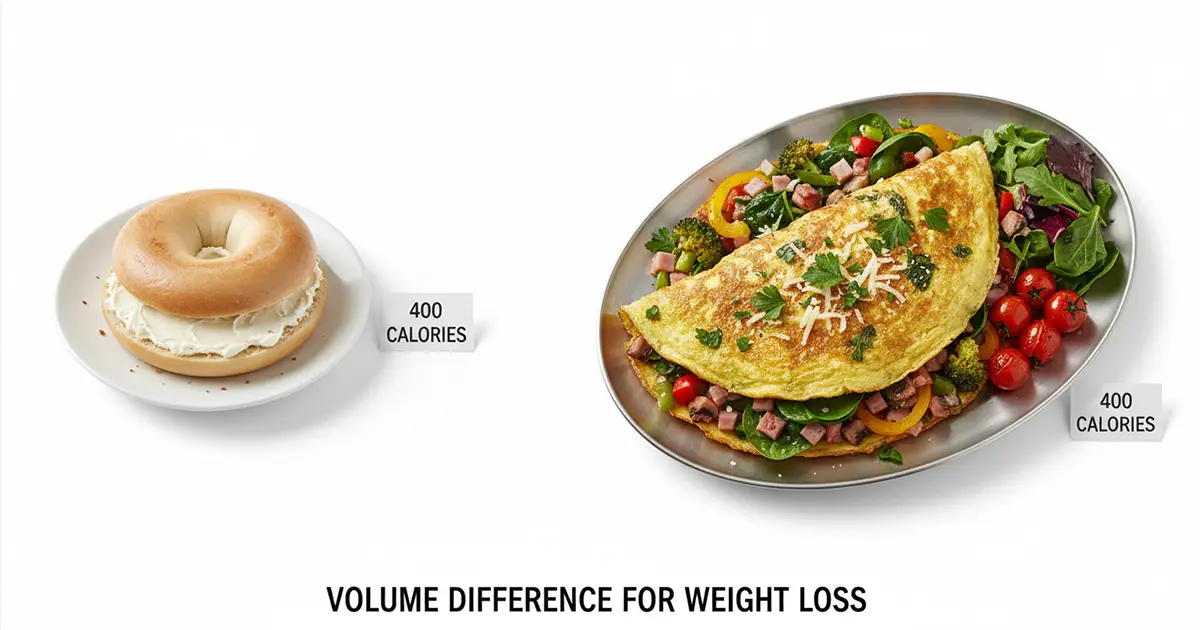
Real talk: I used to eat a 400-calorie bagel for breakfast and was hungry 2 hours later. Now I eat a 380-calorie omelet (3 eggs, veggies, 1 oz cheese) and stay full until lunch, same calories, totally different result. The difference? Protein and volume.
A 2019 study in the Journal of the Academy of Nutrition and Dietetics found that high-protein breakfasts reduced daily calorie intake by an average of 135 calories without conscious effort. Your body just naturally eats less because it’s satisfied.
The Protein-Fiber-Volume Formula
The magic combination for low calorie meals for weight loss:
- Protein: 25-40g per meal (keeps you full 3-4 hours)
- Fiber: 5-10g per meal (slows digestion, steady energy)
- Volume: 2-3 cups of vegetables (physically fills the stomach)
- Healthy fats: 10-15g (prevents flavor fatigue, helps nutrient absorption)
When you hit all four, you create a meal that satisfies hunger hormones, fills your stomach, tastes good, and keeps you full for hours. That’s the difference between a diet you can stick to and one you quit after three days.
For more detailed information on calculating your nutritional needs, check out our complete TDEE calculator guide.
High Protein Low Calorie Meals (The Foundation)
✓ Quick Answer High protein low calorie meals for weight loss should contain 30-40g protein and 350-450 calories. Best sources: chicken breast, fish, Greek yogurt, eggs, tofu, and lean turkey. Pair with vegetables for volume.
Protein is your weight loss superpower. Honestly, if you change nothing else in your diet except increasing your protein intake, you’ll probably lose weight.
Here’s why. Protein burns 20-30% of its calories during digestion, which is called the thermic effect. So if you eat 100 calories of protein, your body burns 20-30 calories just processing it.
Compare that to carbs (5-10%) and fats (0-3%). Research in the American Journal of Clinical Nutrition shows that increasing protein to 30% of calories can boost metabolism by 80-100 calories per day.
But the real magic is satiety. I used to eat “balanced” meals with about 20g of protein, yet I was constantly hungry.
When I switched to 35-40g protein per meal, my constant snacking stopped. I wasn’t white-knuckling through hunger anymore; I just naturally felt satisfied.
Best Protein Sources for Weight Loss
| Food (100g) | Calories | Protein | Protein/Cal Ratio |
|---|---|---|---|
| Chicken breast | 165 | 31g | 0.19 |
| Cod fish | 82 | 18g | 0.22 |
| Egg whites | 52 | 11g | 0.21 |
| Greek yogurt (nonfat) | 59 | 10g | 0.17 |
| Shrimp | 99 | 24g | 0.24 |
| Turkey breast | 135 | 30g | 0.22 |
| Tofu (firm) | 144 | 17g | 0.12 |
Higher ratio = more protein per calorie. Data from USDA FoodData Central
The University of Sydney found that protein is the most satiating macronutrient. Meals with 30-40g protein keep you full significantly longer than those with 10-20g, even at the same calorie level.
10 High Protein Low Calorie Meals
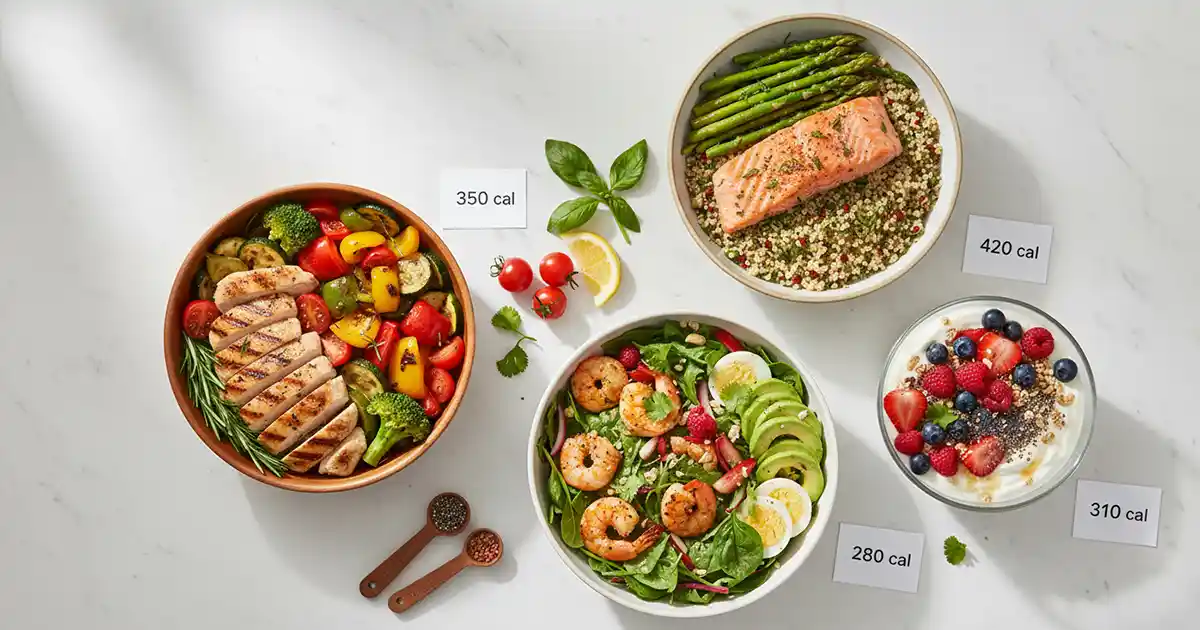
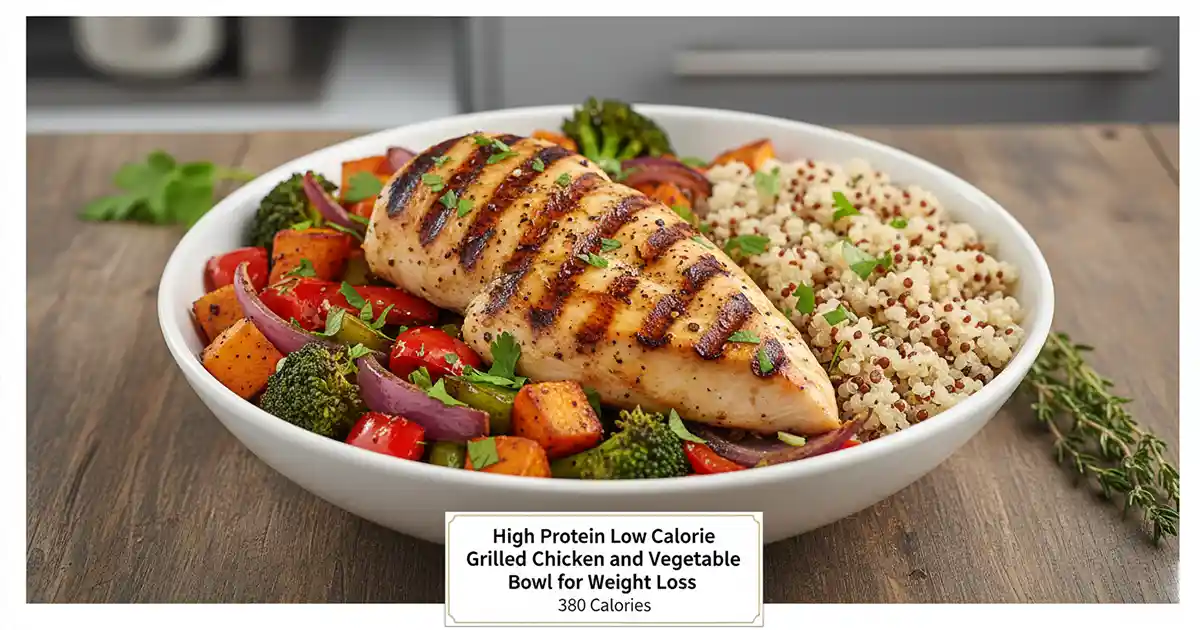
1. Grilled Chicken & Veggie Bowl (380 cal, 42g protein) 6 oz grilled chicken breast, 2 cups roasted broccoli and peppers, 1/2 cup quinoa, lemon juice
2. Salmon & Asparagus (420 cal, 38g protein) 5 oz baked salmon, 2 cups asparagus, herbs, lemon
3. Egg White Veggie Scramble (280 cal, 32g protein) 1 whole egg + 4 whites, spinach, mushrooms, tomatoes, 1 oz feta
4. Greek Yogurt Protein Bowl (310 cal, 35g protein) 1.5 cups nonfat Greek yogurt, 1/2 cup berries, 1 tbsp almonds, cinnamon
5. Turkey Chili (350 cal, 40g protein) Lean ground turkey, beans, tomatoes, peppers, spices (1.5 cup serving)
6. Shrimp Stir-Fry (340 cal, 36g protein) 8 oz shrimp, 3 cups mixed vegetables, coconut aminos, cauliflower rice
7. Chicken Lettuce Wraps (290 cal, 35g protein) Ground chicken, water chestnuts, green onions, romaine leaves
8. Baked Cod with Veggies (310 cal, 34g protein) 6 oz cod, roasted zucchini, cherry tomatoes, garlic
9. Tofu Vegetable Soup (280 cal, 28g protein) Firm tofu, miso broth, bok choy, mushrooms, scallions
10. Turkey & Egg Breakfast (360 cal, 38g protein) 4 oz lean turkey, 2 eggs, 1 cup sautéed spinach, salsa
Pretty much any of these will keep you full for 3-4 hours minimum. I make the chicken and veggie bowl three times a week, prep everything on Sunday, and it takes 5 minutes to heat up for lunch.
For more high protein meal ideas, check out our guide to grilled chicken recipes under 400 calories.
Best Low Calorie Breakfast Ideas for Weight Loss
✓ Quick Answer Best low calorie breakfasts for weight loss are 300-400 calories with 25-35g protein. Top choices: egg-based dishes, Greek yogurt bowls, protein oatmeal, and cottage cheese combinations. Avoid sugary cereals and pastries.
Breakfast sets the tone for your entire day. Start with protein and fiber, and you’ll avoid that mid-morning crash and snack attack.
Research from the International Journal of Obesity found that high-protein breakfasts reduced daily calorie intake by 135 calories on average compared to high-carb breakfasts. Your body just naturally eats less throughout the day when you start with protein.
I used to skip breakfast to “save calories,” but would end up eating 500+ calories in snacks before noon. Now I eat a 350-calorie protein breakfast and don’t even think about food until lunch. Total game changer.
The key is hitting 25-35g of protein within 1-2 hours of waking. According to the Academy of Nutrition and Dietetics, this kickstarts your metabolism and controls appetite hormones for 8+ hours.
15 Low Calorie Breakfast Ideas
Quick Options (Under 10 minutes):
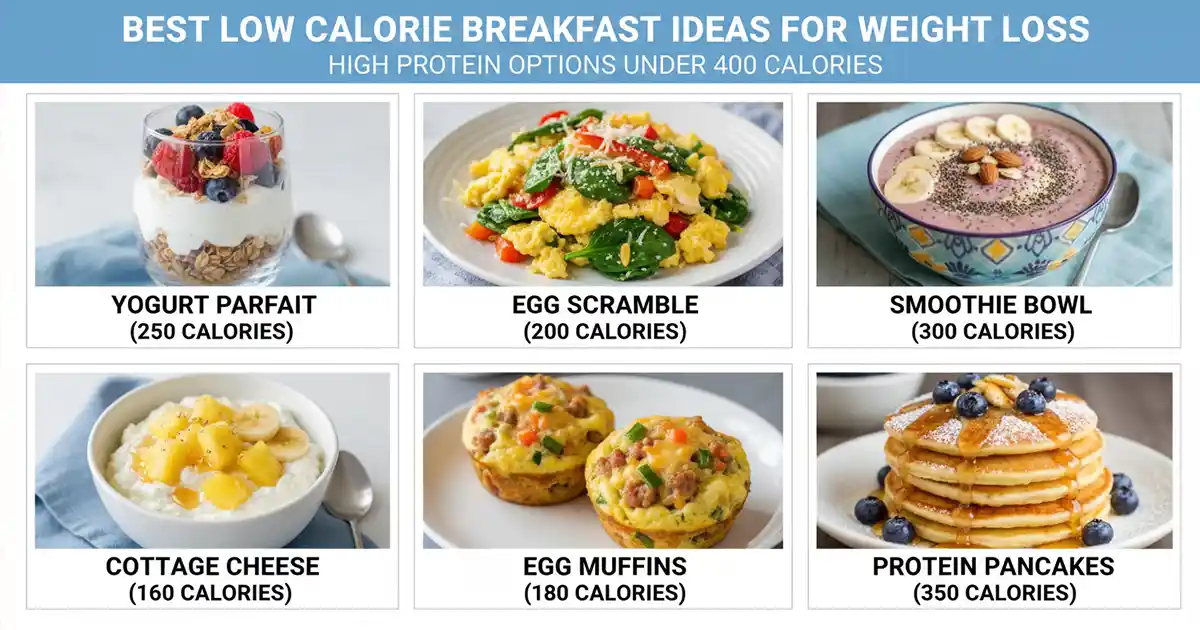
- Greek Yogurt Parfait (320 cal, 28g protein)
- 1.5 cups nonfat Greek yogurt, 1/2 cup berries, 1 tbsp almonds, drizzle honey
- Scrambled Eggs & Avocado Toast (380 cal, 24g protein)
- 3 scrambled eggs, 1/4 avocado on 1 slice whole wheat toast
- Protein Smoothie Bowl (340 cal, 30g protein)
- 1 scoop protein powder, 1 banana, spinach, almond milk, topped with berries
- Cottage Cheese & Berries (290 cal, 26g protein)
- 1.5 cups low-fat cottage cheese, 1 cup mixed berries, cinnamon
- Turkey Sausage & Egg Wrap (360 cal, 32g protein)
- 2 turkey sausage links, 2 eggs, whole wheat tortilla, salsa
Weekend/Meal Prep Options:
- Veggie Egg Muffins (240 cal, 20g protein – 2 muffins)
- Bake eggs with spinach, peppers, cheese in muffin tins
- Overnight Protein Oats (350 cal, 25g protein)
- 1/2 cup oats, 1 scoop protein powder, almond milk, chia seeds, berries
- Breakfast Burrito Bowl (390 cal, 30g protein)
- Scrambled eggs, black beans, salsa, avocado, Greek yogurt
- Smoked Salmon & Egg Plate (310 cal, 28g protein)
- 2 eggs any style, 2 oz smoked salmon, cucumber, tomato
- Protein Pancakes (320 cal, 26g protein)
- Blend 2 eggs, 1 banana, 1/2 cup oats, 1 scoop protein powder
Grab-and-Go:
- Hard-Boiled Eggs & Apple (280 cal, 18g protein)
- 3 hard-boiled eggs, 1 medium apple, handful almonds
- Protein Bar & Banana (300 cal, 20g protein)
- High-protein bar (20g+), 1 banana
- Greek Yogurt & Almonds (270 cal, 22g protein)
- 1 cup Greek yogurt, 1 oz almonds
Sweet Options:
- Protein French Toast (340 cal, 28g protein)
- 2 slices whole wheat bread, 2 eggs, cinnamon, sugar-free syrup
- Almond Butter Banana Toast (360 cal, 15g protein)
- 2 slices whole wheat toast, 2 tbsp almond butter, 1 banana sliced
Honestly, my go-to is the Greek yogurt parfait or egg scramble. Five minutes keeps me full until lunch, and I don’t have to think about it. For more breakfast meal prep ideas, see our overnight oats recipe collection.
Low Calorie Lunch Ideas That Keep You Full
✓ Quick Answer Low calorie lunches for weight loss should be 400-500 calories with high protein (30-40g) and fiber (8-12g). Best options: salad bowls with protein, soup + sandwich combos, grain bowls, and leftovers from dinner. Avoid heavy pastas and fried foods.
Lunch is where most diets fail. Too light and you’re starving by 3 pm; too heavy and you’re sluggish all afternoon.
The sweet spot is 400-500 calories with at least 30g protein. This prevents that afternoon energy crash and stops mindless snacking.
According to USDA research, restaurant lunches average 750-1,000 calories compared to home-packed lunches at 400-500 calories. That’s a 500-calorie difference that adds up fast.
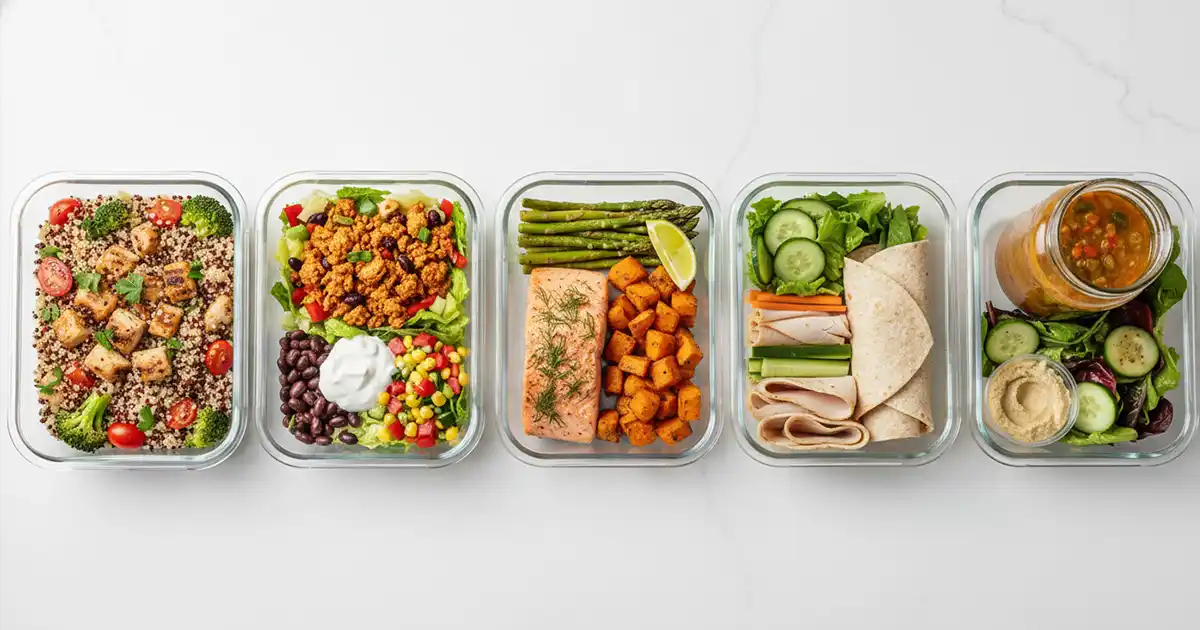
I pack my lunch 4 days a week using Sunday meal prep. Saves me $50 weekly AND 500+ calories per day compared to my old Chipotle habit. No joke, that change alone helped me lose 8 pounds in two months.
20 Low Calorie Lunch Ideas
Salad-Based (High Volume):
- Grilled Chicken Caesar Salad (380 cal, 38g protein)
- 6 oz grilled chicken, romaine, light Caesar, parmesan, croutons
- Taco Salad Bowl (420 cal, 32g protein)
- Ground turkey, lettuce, beans, salsa, Greek yogurt, cheese
- Asian Salmon Salad (410 cal, 34g protein)
- 5 oz salmon, mixed greens, edamame, ginger dressing
- Mediterranean Chickpea Salad (360 cal, 18g protein)
- Chickpeas, cucumber, tomato, feta, olives, lemon vinaigrette
- Cobb Salad (450 cal, 36g protein)
- Chicken, egg, bacon, avocado, tomato, blue cheese
Soup + Protein:
- Turkey Chili + Side Salad (400 cal, 35g protein)
- 1.5 cups of turkey chili, small garden salad
- Chicken Vegetable Soup + Crackers (340 cal, 28g protein)
- 2 cups of soup, whole grain crackers
- Lentil Soup + Hard-Boiled Eggs (380 cal, 24g protein)
- 1.5 cups of lentil soup, 2 hard-boiled eggs
Bowl-Based:
- Chicken Quinoa Bowl (440 cal, 38g protein)
- 6 oz chicken, 1/2 cup quinoa, roasted vegetables, tahini
- Shrimp Rice Bowl (390 cal, 32g protein)
- 6 oz shrimp, 1/2 cup brown rice, stir-fried vegetables
- Tofu Buddha Bowl (370 cal, 26g protein)
- Baked tofu, sweet potato, broccoli, and tahini dressing
- Beef Burrito Bowl (460 cal, 40g protein)
- Lean ground beef, cauliflower rice, beans, salsa, cheese
Sandwich/Wrap:
- Turkey Avocado Wrap (380 cal, 30g protein)
- 4 oz turkey, avocado, lettuce, tomato, whole wheat wrap
- Tuna Salad on Whole Wheat (350 cal, 28g protein)
- Tuna with light mayo, lettuce, tomato, and 2 slices of bread
- Chicken Pita Pocket (340 cal, 32g protein)
- Grilled chicken, hummus, vegetables, whole wheat pita
Leftover Transformations:
- Last Night’s Chicken + Fresh Salad (400 cal, 36g protein)
- 6 oz leftover chicken, large mixed green salad
- Salmon + Veggie Stir-Fry (420 cal, 34g protein)
- Leftover salmon reheated with fresh stir-fried vegetables
Quick Options:
- Greek Yogurt + Trail Mix + Apple (360 cal, 24g protein)
- 1.5 cups Greek yogurt, 1 oz trail mix, apple
- Cottage Cheese + Crackers + Veggies (320 cal, 26g protein)
- 1.5 cups cottage cheese, whole grain crackers, raw vegetables
- Protein Smoothie + Almonds (380 cal, 30g protein)
- Protein shake with banana and berries, 1 oz almonds
Restaurant Lunch Swaps
| Instead of… | Choose… | Calorie Savings |
|---|---|---|
| Caesar wrap (800 cal) | Chicken Caesar salad (380 cal) | -420 cal |
| Pasta bowl (950 cal) | Grain bowl (440 cal) | -510 cal |
| Burger + fries (1,100 cal) | Turkey burger, no bun, side salad (420 cal) | -680 cal |
Look, eating out occasionally is fine. Just be strategic. For a complete guide to navigating restaurants while losing weight, see our dining out survival guide.
Low Calorie Dinner Recipes Under 500 Calories
✓ Quick Answer Low calorie dinners for weight loss should be 400-550 calories with 35-45g protein. Best options: grilled proteins with roasted vegetables, stir-fries, one-pan meals, and lean meat with cauliflower rice. Focus on satisfying, family-friendly meals.
Dinner doesn’t have to be boring chicken and broccoli; these 25 recipes prove you can enjoy delicious, satisfying meals while losing weight.
You’ve got room for 400-550 calories at dinner, which is enough for a genuinely satisfying meal. Research from Cornell University’s Food Lab shows that filling half your plate with vegetables naturally reduces calorie intake by 20-30% without feeling deprived.
My family doesn’t even realize these are “diet meals.” Last week, I made the creamy Tuscan chicken, my husband asked for seconds, and was shocked when I told him it was only 510 calories per serving. His usual pasta dinner? Over 900 calories.
25 Low Calorie Dinner Ideas
Chicken-Based:
- Lemon Garlic Chicken & Asparagus (420 cal, 42g protein)
- 6 oz chicken breast, 2 cups asparagus, lemon, garlic, herbs
- Chicken Fajita Bowl (460 cal, 40g protein)
- Grilled chicken, peppers, onions, cauliflower rice, salsa, and Greek yogurt
- Baked Chicken Parmesan (480 cal, 45g protein)
- Breaded baked chicken, marinara, mozzarella, zucchini noodles
- Teriyaki Chicken Stir-Fry (440 cal, 38g protein)
- Chicken, broccoli, snap peas, carrots, teriyaki sauce, brown rice
- Chicken Taco Lettuce Wraps (380 cal, 36g protein)
- Seasoned ground chicken, romaine leaves, salsa, cheese, avocado
- Mediterranean Chicken Skillet (450 cal, 40g protein)
- Chicken thighs, tomatoes, olives, artichokes, feta
- BBQ Chicken & Sweet Potato (490 cal, 42g protein)
- Grilled BBQ chicken, baked sweet potato, green beans
- Creamy Tuscan Chicken (510 cal, 44g protein)
- Chicken in cream sauce with sun-dried tomatoes, spinach, and parmesan
Seafood:
- Baked Salmon & Broccoli (430 cal, 38g protein)
- 5 oz salmon, 2 cups roasted broccoli, lemon, dill
- Shrimp Scampi with Zoodles (360 cal, 34g protein)
- Shrimp in garlic butter sauce, zucchini noodles, parmesan
- Blackened Tilapia Tacos (410 cal, 36g protein)
- Blackened tilapia, corn tortillas, cabbage slaw, lime crema
- Garlic Butter Shrimp (340 cal, 32g protein)
- Sautéed shrimp, green beans, garlic, butter, lemon
- Lemon Herb Cod (380 cal, 35g protein)
- Baked cod, roasted asparagus, cherry tomatoes, and herbs
- Tuna Poke Bowl (450 cal, 40g protein)
- Fresh tuna, cauliflower rice, edamame, avocado, sesame
Beef/Pork:
- Lean Beef Stir-Fry (480 cal, 42g protein)
- Lean beef strips, mixed vegetables, ginger sauce, and cauliflower rice
- Pork Tenderloin & Green Beans (440 cal, 40g protein)
- Roasted pork tenderloin, 2 cups green beans, garlic
- Turkey Meatballs & Marinara (420 cal, 38g protein)
- Lean turkey meatballs, marinara sauce, zucchini noodles
- Beef Taco Bowl (490 cal, 44g protein)
- Lean ground beef, lettuce, beans, salsa, cheese, Greek yogurt
- Pork Chop & Roasted Veggies (460 cal, 40g protein)
- Grilled pork chop, roasted Brussels sprouts, sweet potato
Vegetarian:
- Tofu Veggie Stir-Fry (380 cal, 28g protein)
- Firm tofu, broccoli, bell peppers, snap peas, soy sauce
- Lentil Curry (410 cal, 22g protein)
- Lentils, coconut milk, curry spices, spinach, cauliflower rice
- Black Bean Burrito Bowl (440 cal, 20g protein)
- Black beans, brown rice, vegetables, salsa, avocado
- Chickpea Tikka Masala (390 cal, 18g protein)
- Chickpeas in tikka sauce, cauliflower, spinach, yogurt
One-Pan/Sheet Pan:
- Sheet Pan Chicken & Veggies (450 cal, 42g protein)
- Chicken breast, broccoli, peppers, onions, olive oil, herbs
- One-Pan Sausage & Peppers (470 cal, 32g protein)
- Turkey sausage, bell peppers, onions, and marinara
The Perfect Weight Loss Dinner Formula:
- Protein (6-8 oz): 200-300 calories
- Vegetables (2-3 cups): 50-100 calories
- Healthy fat (1-2 tsp oil/sauce): 50-80 calories
- Optional starch (1/2 cup): 100-150 calories
- Total: 400-550 calories
For even more dinner ideas, browse our complete collection of chicken recipes under 500 calories and sheet pan dinners for weight loss.
Low Calorie Meal Plan for Weight Loss (7-Day Sample)
✓ Quick Answer A 1,400-1,500 calorie meal plan for weight loss includes three 400-450 calorie meals plus one 150-200 calorie snack. This creates a safe deficit for most women. Men add 200-300 calories via larger portions or extra snack.
Meal planning removes decision fatigue and prevents the “what should I eat?” panic that leads to ordering pizza.
Following a meal plan for just 2 weeks completely changed my relationship with food. I stopped stressing about every meal and finally saw consistent weight loss, 10 lbs in 6 weeks.
Research in the International Journal of Behavioral Nutrition found that meal planning is associated with healthier diet quality and lower obesity rates.
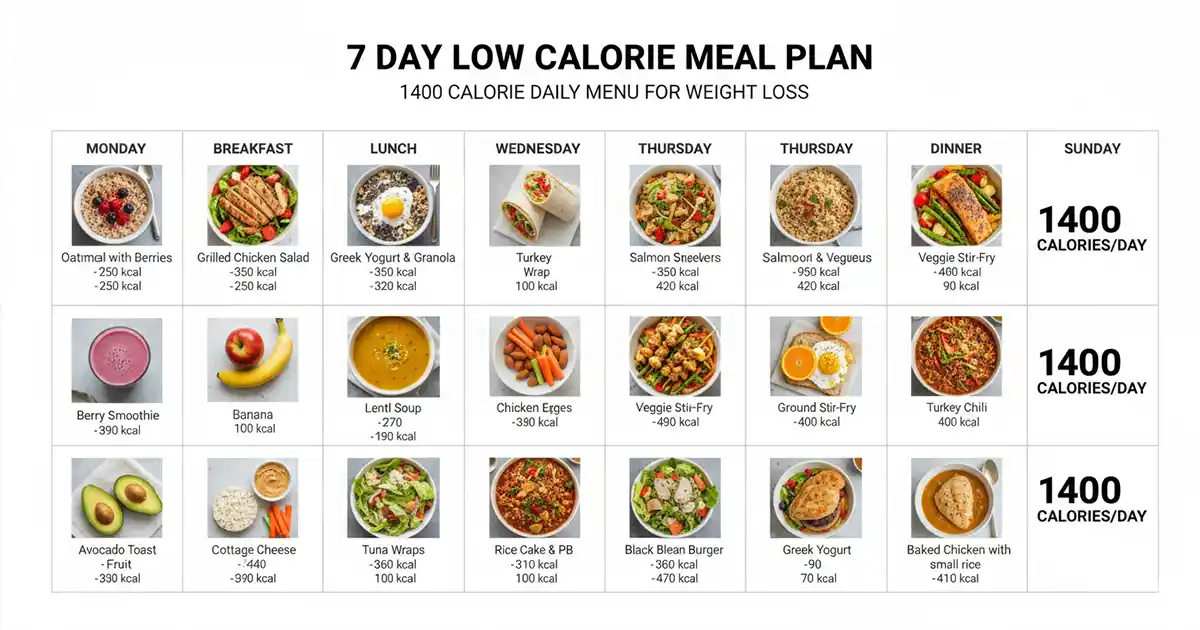
Here’s a full week at approximately 1,450 calories daily. Treat this as a template, swap similar meals to keep it interesting.
7-Day Sample Meal Plan
Monday (1,430 calories)
- Breakfast: Greek Yogurt Parfait (320 cal, 28g protein)
- Lunch: Grilled Chicken Caesar Salad (380 cal, 38g protein)
- Snack: Apple + Almonds (180 cal, 6g protein)
- Dinner: Baked Salmon & Asparagus (550 cal, 40g protein)
Tuesday (1,460 calories)
- Breakfast: Veggie Egg Scramble (340 cal, 30g protein)
- Lunch: Turkey Chili (400 cal, 35g protein)
- Snack: Cottage Cheese & Berries (170 cal, 15g protein)
- Dinner: Chicken Fajita Bowl (550 cal, 42g protein)
Wednesday (1,420 calories)
- Breakfast: Protein Oatmeal (350 cal, 25g protein)
- Lunch: Tuna Salad Wrap (350 cal, 28g protein)
- Snack: Protein Bar (200 cal, 20g protein)
- Dinner: Shrimp Stir-Fry (520 cal, 38g protein)
Thursday (1,440 calories)
- Breakfast: Scrambled Eggs & Avocado Toast (380 cal, 24g protein)
- Lunch: Leftover Turkey Chili (400 cal, 35g protein)
- Snack: Greek Yogurt (150 cal, 15g protein)
- Dinner: Lemon Garlic Chicken (510 cal, 42g protein)
Friday (1,470 calories)
- Breakfast: Smoothie Bowl (340 cal, 30g protein)
- Lunch: Chicken Quinoa Bowl (440 cal, 38g protein)
- Snack: String Cheese + Grapes (180 cal, 8g protein)
- Dinner: Beef Taco Bowl (510 cal, 44g protein)
Saturday (1,450 calories)
- Breakfast: Protein Pancakes (320 cal, 26g protein)
- Lunch: Mediterranean Chickpea Salad (360 cal, 18g protein)
- Snack: Trail Mix (200 cal, 8g protein)
- Dinner: Sheet Pan Chicken & Veggies (570 cal, 45g protein)
Sunday (1,440 calories)
- Breakfast: Turkey Sausage & Egg Wrap (360 cal, 32g protein)
- Lunch: Leftover Sheet Pan Chicken (450 cal, 42g protein)
- Snack: Protein Shake (180 cal, 25g protein)
- Dinner: Pork Tenderloin & Green Beans (450 cal, 40g protein)
Weekly Totals:
- Average: 1,444 calories/day
- Protein: 120-140g daily
- Estimated weight loss: 1-1.5 lbs/week
Sunday Meal Prep Checklist
Spend 2 hours on Sunday setting yourself up for success:
☐ Cook 3 lbs chicken breast (use Mon, Wed, Sat)
☐ Make turkey chili (4 servings)
☐ Hard-boil 12 eggs
☐ Chop vegetables for the week
☐ Portion snacks into bags
☐ Cook quinoa/rice for bowls
☐ Prep overnight oats if using
How to Customize This Plan
For men: Add 200-300 calories by:
- Increasing protein portions by 2 oz
- Adding another 100-calorie snack
- Including an extra 1/2 cup of grains at meals
Vegetarians: Swap animal proteins for:
- Tofu/tempeh (same portion sizes)
- Lentils/beans (1.5 cups cooked)
- Extra eggs or Greek yogurt
Grocery List for the Week
Protein ($25):
- 3 lbs chicken breast
- 1 lb ground turkey
- 1 lb salmon
- 1 lb shrimp
- 18 eggs
- 2 lbs Greek yogurt
Vegetables ($15):
- Mixed greens/lettuce
- Broccoli, asparagus, green beans
- Peppers, onions, and tomatoes
- Spinach, mushrooms
Carbs ($10):
- Quinoa, brown rice
- Whole wheat bread/wraps
- Oats
Other ($15):
- Cottage cheese
- String cheese
- Almonds, trail mix
- Fruit (apples, berries, bananas)
- Spices, sauces
Total: $65/week (~$3.10/meal)
Download our free printable meal plan and grocery list to make this easy. For more meal planning strategies, check out our meal prep for beginners guide.
Budget-Friendly Low Calorie Meals for Weight Loss
✓ Quick Answer Budget low calorie meals use affordable proteins (eggs, canned tuna, chicken thighs), frozen vegetables, and pantry staples (rice, beans, oats). Average cost: $3-5 per meal. Meal planning and buying in bulk saves 30-40% compared to convenience foods.
Eating healthy doesn’t require expensive organic groceries or trendy superfoods. I’m going to prove it.
I used to spend $12-15 per meal eating out. Now I meal prep for $65 per week, that’s saving $400+ monthly while actually losing weight. According to USDA data, the average American spends $3,240 annually on food away from home versus $1,820 on groceries. Switching saves $1,400+ yearly.
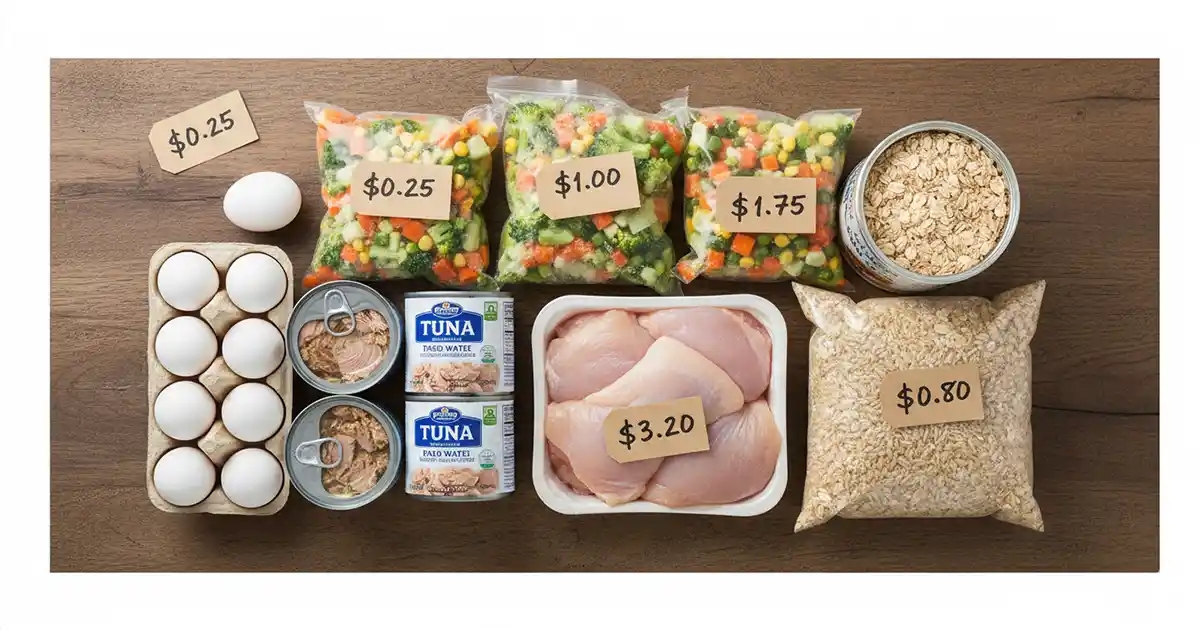
The secret is knowing which proteins give you the most bang for your buck. Eggs cost about $0.25 each and pack 6g of protein. Canned tuna is $1 per can with 25g of protein. Chicken thighs run $2/lb compared to $5/lb for breasts, and honestly taste better.
10 Budget Low Calorie Meals Under $3.50
- Egg & Veggie Scramble ($1.80, 340 cal, 28g protein)
- 3 eggs, spinach, onions, peppers from frozen bag
- Tuna Salad on Crackers ($2.20, 320 cal, 26g protein)
- 1 can of tuna, light mayo, whole grain crackers, cucumber
- Chicken Thigh Rice Bowl ($3.50, 450 cal, 38g protein)
- 6 oz chicken thighs, 1/2 cup rice, frozen mixed vegetables
- Lentil Soup ($1.50, 380 cal, 20g protein)
- Dry lentils, canned tomatoes, frozen vegetables, spices
- Oatmeal Power Bowl ($1.40, 350 cal, 15g protein)
- 1/2 cup oats, banana, 2 tbsp peanut butter, milk
- Bean & Cheese Burrito ($2.00, 400 cal, 22g protein)
- Canned black beans, tortilla, cheese, and salsa
- Scrambled Eggs & Toast ($1.60, 320 cal, 22g protein)
- 3 eggs, 2 slices whole wheat bread, butter
- Frozen Veggie Stir-Fry ($3.20, 410 cal, 30g protein)
- Chicken thighs, frozen stir-fry vegetables, soy sauce, rice
- Chickpea Curry ($2.40, 390 cal, 18g protein)
- Canned chickpeas, coconut milk, curry powder, frozen spinach
- Turkey & Rice Skillet ($3.30, 440 cal, 35g protein)
- Ground turkey (on sale), rice, canned tomatoes, frozen vegetables
Weekly Budget Breakdown
| Category | Weekly Cost | What to Buy |
|---|---|---|
| Protein | $25 | 3 lbs chicken thighs, 18 eggs, 4 cans tuna, 1 lb ground turkey |
| Vegetables | $15 | Frozen mixed vegetables, lettuce, onions, canned tomatoes |
| Carbs | $10 | Rice, oats, whole wheat bread, pasta |
| Dairy | $8 | Greek yogurt, cheese, milk |
| Pantry | $7 | Beans, lentils, spices, cooking oil, peanut butter |
| Total | $65/week | ~$3.10 per meal (21 meals) |
Money-Saving Tips
Buy frozen vegetables. They’re 50% cheaper than fresh, just as nutritious, and zero waste. The CDC confirms frozen vegetables retain nutrients because they’re flash-frozen at peak ripeness.
Stock pantry staples. Rice, oats, and dried beans last months and cost pennies per serving. A $5 bag of rice makes 40+ servings.
Shop sales and bulk. When chicken goes on sale, buy 5 lbs and freeze in portions. Eggs bought in bulk save $1+ per dozen.
Skip organic for the budget. The USDA’s “Dirty Dozen” list matters for pesticides, but if you’re on a budget, conventional produce is fine. Wash thoroughly.
For complete budget shopping strategies, see our guide to cheap high protein foods and budget grocery shopping tips.
Meal Prep Strategies for Weight Loss Success
✓ Quick Answer Successful meal prep for weight loss involves: planning 3-5 days ahead, cooking proteins in bulk, chopping vegetables, portioning snacks, and using proper containers. Dedicate 2-3 hours Sunday for the week ahead.
Meal prep isn’t about eating the same boring meal 7 times; it’s about having healthy options ready when hunger strikes.
I prep Sunday for Mon-Thu, then cook fresh Fri-Sun. This “partial prep” approach keeps me on track without feeling robotic about my meals.
Research in the Journal of Nutrition Education and Behavior shows that meal preppers consume 50% more vegetables and have better weight loss outcomes.
Look, I get it. The idea of spending your Sunday cooking sounds terrible. But 2-3 hours one day beats the stress of figuring out what to eat six times daily for a week. And honestly, once you get in the routine, it’s kind of therapeutic.
Step-by-Step Meal Prep Process
Hour 1: Proteins
- Season 3 lbs chicken breast → Bake at 400°F for 25 minutes
- Brown 2 lbs ground turkey → Cook in large skillet, 15 minutes
- Hard boil 12 eggs → 12 minutes, ice bath
Hour 2: Vegetables & Carbs
- Chop lettuce, peppers, cucumbers → Store in separate containers
- Roast 4 cups mixed vegetables → 425°F for 20 minutes
- Cook 4 cups rice or quinoa → Rice cooker or pot, 20 minutes
Hour 3: Assemble & Portion
- Divide proteins into 6-8 portions (each 4-6 oz)
- Portion snacks into bags (nuts, fruit, crackers)
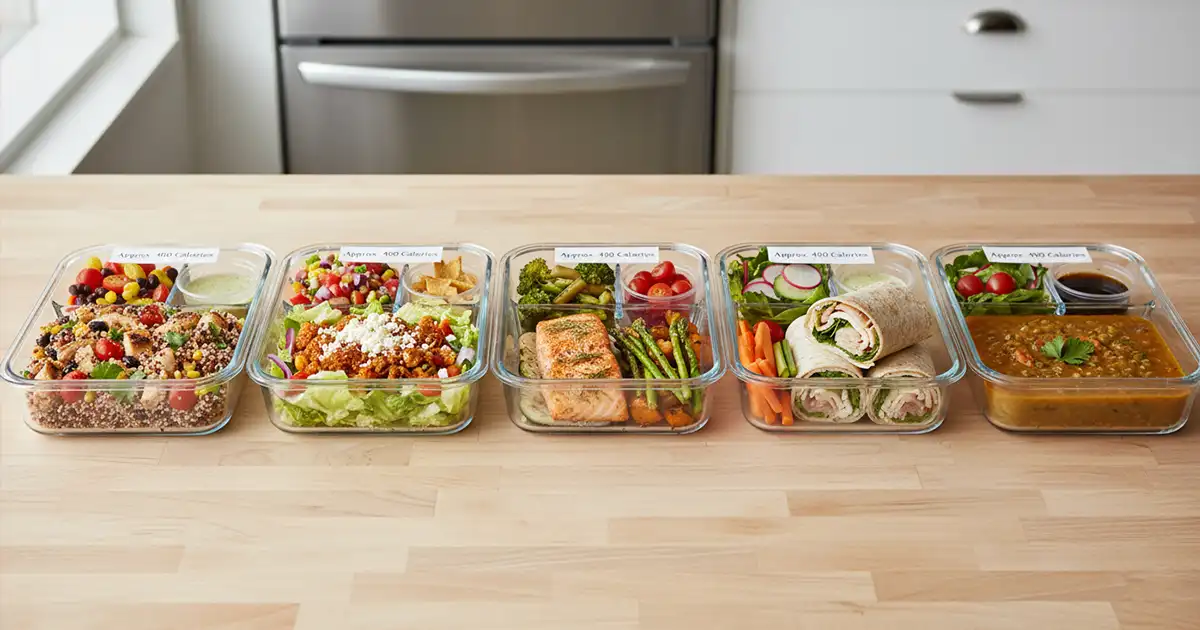
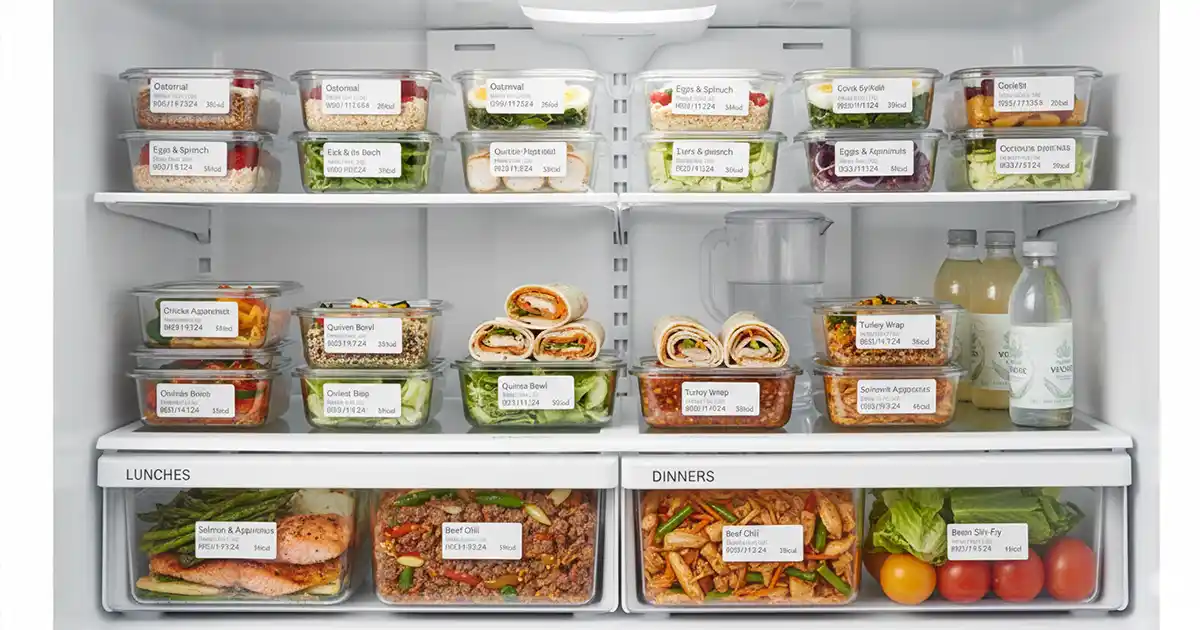
- Label containers with calories and date
- Organize fridge strategically (grab-and-go placement)
Mix & Match Strategy
This is the key to avoiding meal fatigue. Instead of making 5 identical meals, prep components separately and mix them differently each day.
Base (Pick 1):
- Rice
- Quinoa
- Cauliflower rice
- Lettuce
Protein (Pick 1):
- Chicken
- Turkey
- Salmon
- Tofu
- Eggs
Veggies (Pick 2-3):
- Broccoli
- Peppers
- Spinach
- Asparagus
- Green beans
Endless combinations from the same Sunday prep. Monday might be chicken, rice, and broccoli. Tuesday is turkey, quinoa, and peppers. Wednesday is chicken, lettuce (salad), and cucumber. You get the idea.
Best Meal Prep Containers
Glass containers ($25-40 for 10-pack): Glass is best, microwave safe, doesn’t stain, lasts forever. Worth the investment.
BPA-free plastic ($15-20 for 10-pack): Cheaper option, but replace yearly.
Size guide:
- Lunch/dinner: 28-32 oz (2-3 compartments ideal)
- Breakfast: 16-20 oz
- Snacks: 8-12 oz
What NOT to Meal Prep
Some foods don’t store well. Cook these fresh:
- Crispy foods (get soggy)
- Delicate fish (texture suffers)
- Avocado (browns)
- Fresh salads fully assembled (wilt)
Storage times:
- Cooked proteins: 4 days max
- Cooked vegetables: 5-6 days
- Chopped raw vegetables: 5-7 days
- Hard-boiled eggs: 7 days
For video tutorials and more detailed strategies, check out our meal prep for beginners video guide and food storage guidelines.
How to Stay Satisfied While Losing Weight
✓ Quick Answer Stay satisfied during weight loss by: eating protein at every meal, choosing high-volume foods, planning indulgences (not restricting completely), staying hydrated, getting adequate sleep, and managing stress. It’s about consistency, not perfection.
Weight loss doesn’t require misery. Let me say that again, you don’t have to be miserable to lose weight.
I used to think I had to be perfect 100% of the time. That lasted about 4 days before I’d crack and eat an entire pizza. Now I eat Mon-Fri strictly, then enjoy pizza Friday night and brunch Saturday, still losing 1 lb per week because my weekly average stays on target.
Research in the journal Obesity found that flexible dieters (allowing treats) had 50% better long-term weight loss maintenance than rigid dieters. The all-or-nothing approach fails because it’s unsustainable.
10 Satisfaction Strategies
1. Front-load protein. Eat your protein first at each meal. According to the American Journal of Clinical Nutrition, this naturally reduces total meal calories by preventing overeating.
2. Drink water before meals. A study from Virginia Tech found that drinking 16 oz of water before meals led to consuming 15% fewer calories without trying.
3. Use larger plates for vegetables. Visual trick from Cornell’s Food Lab, bigger plates make vegetable portions look normal, not skimpy.
4. Plan one treat daily. Budget 150-200 calories for something you genuinely enjoy. I have a small piece of dark chocolate every night. Keeps me sane.
5. Don’t skip meals. Skipping breakfast or lunch to “save calories” backfires. You’ll be ravenously hungry and overeat later.
6. Eat slowly. Takes 20 minutes for satiety signals to reach your brain. Put your fork down between bites. Seriously.
7. Keep trigger foods out. Don’t rely on willpower. If chips are your weakness, don’t buy them. I can’t be trusted around peanut butter (I’ll eat the jar with a spoon), so I buy individual packets.
8. Schedule restaurant meals. Planning means you can look forward to it without anxiety. I plan Friday dinner out, I know it’s coming, so I’m not tempted during the week.
9. Sleep 7-9 hours. Poor sleep increases hunger hormones (ghrelin) by 15-20% according to the NIH. You’ll be hungrier the next day. Not negotiable.
10. Find non-food rewards. Celebrate weight loss milestones without food. New workout clothes, massage, concert tickets, whatever makes you happy.
The 80/20 Rule
Weekly Calorie Budget (1,400/day = 9,800/week)
- 80% “Clean” meals: 7,840 calories → Weight loss foods
- 20% Flexibility: 1,960 calories → Pizza, wine, dessert
This allows 2-3 treats weekly while staying in deficit. Your body cares about weekly averages, not daily perfection.
Managing Social Situations
Restaurants: Check the menu online ahead. Order grilled proteins, vegetables, dressing on side. Skip bread basket. Box half immediately if portions are huge.
Parties: Eat a protein-rich snack before going so you’re not starving. Bring a healthy dish to share. One plate, fill half with vegetables, then enjoy the party.
Family dinners: Portion control. Take smaller servings of high-calorie foods, fill up on vegetables and protein.
What to Do When You’re Still Hungry
Sometimes you’re genuinely hungry, and that’s okay. Options:
- Add vegetables. Eat 2 cups of raw vegetables with salsa or hummus (under 100 calories)
- Drink water or tea. Sometimes thirst masquerades as hunger
- Protein snack. Greek yogurt, hard-boiled egg, or protein shake
- Wait 20 minutes. Often, the feeling passes
The goal is sustainable weight loss, not suffering. For more tips on handling cravings and social eating, see our restaurant survival guide.

Common Mistakes to Avoid with Low Calorie Meals
✓ Quick Answer Biggest low calorie diet mistakes: eating too few calories (under 1,200), not enough protein, liquid calories, skipping meals, overly restrictive rules, ignoring hunger cues, and expecting perfection. Sustainable weight loss requires balance.
I spent 2 years yo-yo dieting making these exact mistakes. Once I stopped, I lost 28 lbs and kept it off. Learn from my failures.
10 Common Mistakes
1. Going Too Low (Under 1,200 Calories)
Why it fails: Slows metabolism, triggers binge eating, causes muscle loss. Your body enters “starvation mode” and holds onto fat.
Fix: Stick to 1,200-1,500 for women, 1,500-1,800 for men. The CDC emphasizes very low calorie diets should only be done under medical supervision.
2. Not Enough Protein
Why it fails: Constant hunger, muscle loss, cravings, slower metabolism. I learned this the hard way eating 1,300 calories of mostly carbs, was hungry all day.
Fix: 25-40g protein per meal, minimum. Make it non-negotiable.
3. Drinking Your Calories
Why it fails: Liquid calories don’t satisfy. A 300-calorie smoothie leaves you hungrier than a 300-calorie chicken salad. Research shows liquid calories don’t trigger the same satiety response.
Fix: Save calories for food that chews. Drink water, black coffee, unsweetened tea. If you want a smoothie, make sure it has 30g+ protein.
4. Skipping Meals to “Save Calories”
Why it fails: Leads to extreme hunger and overeating later. Your body’s hunger hormones go haywire.
Fix: Eat 3 meals + 1 snack daily on a schedule. Consistency matters.
5. All-or-Nothing Thinking
Why it fails: One “bad” meal turns into “I blew it, might as well quit.” This was my biggest problem. Ate a cookie, then ate 10 cookies because “the day was already ruined.”
Fix: One meal doesn’t matter. Get back on track next meal. According to the National Weight Control Registry, successful losers don’t let slip-ups derail them.
6. Ignoring Hunger Cues
Why it fails: Hunger is a signal, not something to “tough out.” Ignoring it leads to eventual binging.
Fix: If you’re genuinely hungry (not bored), eat. Choose protein and fiber. Your body’s smarter than you think.
7. Over-Restricting Food Groups
Why it fails: “No carbs ever!” or “No fats!” leads to intense cravings and binges. Your body needs all macronutrients.
Fix: All foods fit in moderation. 80/20 rule. Focus on mostly whole foods, allow treats.
8. Not Planning Ahead
Why it fails: “What should I eat?” at 6pm when you’re exhausted leads to impulsive pizza orders.
Fix: Meal prep minimum 3-5 days. Have backup options (frozen protein, canned tuna, eggs).
9. Comparing Your Progress to Others
Why it fails: Sally lost 10 lbs your first month, you lost 3. Now you’re discouraged. Everyone’s body is different.
Fix: 1-2 lbs per week is perfect progress. That’s 12-24 lbs in 3 months, life-changing results.
10. Giving Up After One Bad Week
Why it fails: Weight loss isn’t linear. Water retention, hormones, stress all affect the scale daily.
Fix: Look at monthly trends, not daily or weekly. I fluctuate 3-5 lbs throughout my cycle, totally normal.
The Metabolism Myth
“I ruined my metabolism by dieting!” You probably didn’t. While extreme calorie restriction can slightly lower metabolism, it’s reversible. Research shows metabolism returns to normal once you eat adequately again.
What really happens: You lose weight, your body needs fewer calories (smaller body = lower energy needs). This is normal physics, not damage.
For more on breaking through plateaus and handling setbacks, see our guide on overcoming weight loss plateaus.

Frequently Asked Questions About Low Calorie Meals for Weight Loss
How many calories should I eat per meal to lose weight?
Women should aim for 300-500 calories per meal (1,200-1,500 daily total); men should aim for 400-600 calories per meal (1,500-1,800 daily total). This creates a safe 500-750 calorie deficit for 1-1.5 lbs weekly weight loss according to NIH Body Weight Guidelines.
The exact number depends on your height, weight, age, and activity level. Use the NIH Body Weight Planner to calculate your personalized target. Never go below 1,200 calories (women) or 1,500 calories (men) without medical supervision.
What are the best low calorie meals for fast weight loss?
High protein, high fiber meals under 500 calories work best: grilled chicken with vegetables (380 cal), salmon and asparagus (420 cal), egg white omelets (280 cal), turkey chili (350 cal), and shrimp stir-fry (340 cal). Protein keeps you full and preserves muscle during weight loss.
Research from the American Journal of Clinical Nutrition shows that high-protein meals increase metabolism and reduce daily calorie intake by 80-100 calories automatically. Focus on lean proteins paired with non-starchy vegetables for maximum satiety.
Can I lose weight eating 1200 calories a day?
Yes, most women can lose 1-2 lbs weekly on 1,200 calories if meals are balanced with adequate protein, fiber, and nutrients. However, never stay at 1,200 calories long-term without medical supervision, it’s the minimum for women.
The key is making those 1,200 calories count. Prioritize whole foods: lean proteins, vegetables, fruits, whole grains, and healthy fats. Avoid wasting calories on processed foods that don’t satisfy hunger. According to the CDC, this creates approximately a 500-calorie deficit for most women.
Are low calorie meals actually filling?
Yes, when they include protein (25-40g), fiber (5-10g), and high-volume foods like vegetables. A 400-calorie meal with chicken, broccoli, and quinoa is far more satisfying than a 400-calorie muffin because of protein and fiber’s effect on hunger hormones (peptide YY and GLP-1).
The University of Sydney’s Satiety Index Study found that protein-rich, high-fiber foods like eggs, fish, and oatmeal rank highest for fullness per calorie. Volume also matters, physically filling your stomach with low-calorie-density foods triggers stretch receptors that signal satiety.
What low calorie meals keep you full the longest?
High protein meals with fiber: Greek yogurt parfaits (320 cal, full 4 hours), egg scrambles with vegetables (340 cal, full 3-4 hours), chicken and quinoa bowls (440 cal, full 4-5 hours), and salmon with vegetables (430 cal, full 4 hours). Protein takes 3-4 hours to digest compared to 1-2 hours for carbs.
Research in the Journal of the Academy of Nutrition and Dietetics found that meals with 30-40g protein and 8-12g fiber maintain satiety longest. Add healthy fats (10-15g) for even better satisfaction, they slow digestion and improve nutrient absorption.
How much protein should low calorie meals have?
Aim for 25-40g protein per meal for optimal satiety and muscle preservation during weight loss. This translates to: 4-6 oz chicken or fish, 3-4 whole eggs, 1.5 cups Greek yogurt, or 6-8 oz tofu. Protein should be 30-35% of daily calories according to the Academy of Nutrition and Dietetics.
Higher protein intake during weight loss preserves lean muscle mass, increases metabolism through the thermic effect of food (20-30% of calories burned during digestion), and significantly reduces hunger.
The American Journal of Clinical Nutrition recommends even higher protein (up to 40% of calories) for faster weight loss.
Can I eat low calorie meals every day and still lose weight?
Yes, consistent daily calorie deficit through balanced low calorie meals is the proven method for sustainable weight loss. Eating 1,200-1,500 calories daily (women) or 1,500-1,800 (men) creates a deficit leading to 1-2 lbs weekly loss, the recommended safe rate by CDC and NIH.
The key is consistency. According to the National Weight Control Registry, which tracks successful losers who’ve maintained 30+ lb weight loss for 5+ years, eating consistent, structured meals (not yo-yo dieting) is one of the strongest predictors of long-term success.
What should I eat for breakfast on a low calorie diet?
Best options: Greek yogurt parfaits (320 cal, 28g protein), veggie egg scrambles (340 cal, 30g protein), protein oatmeal (350 cal, 25g protein), or scrambled eggs with avocado toast (380 cal, 24g protein). High protein breakfasts reduce daily calorie intake by 135 calories average.
Research from the International Journal of Obesity found that protein-rich breakfasts (30g+) improve satiety, reduce cravings, and lower overall daily calorie intake compared to high-carb breakfasts. Aim to eat within 1-2 hours of waking to kickstart metabolism and control appetite hormones.
Are low calorie meals expensive?
No, budget-friendly options like eggs ($0.25 each), canned tuna ($1/can), chicken thighs ($2/lb), and frozen vegetables cost $2-4 per meal. Meal prepping and buying in bulk saves 30-40% versus convenience foods according to USDA Economic Research data.
Weekly grocery budget for all low calorie meals: $50-70. Compare this to eating out, which averages $12-15 per meal. The USDA reports Americans spend $3,240 annually on food away from home versus $1,820 on groceries. Switching to home cooking saves $1,400+ yearly while improving health.
How long does it take to lose weight on low calorie meals?
Expect 1-2 lbs per week with a 500-750 calorie daily deficit, the safe, sustainable rate recommended by medical experts. That’s 4-8 lbs monthly or 12-24 lbs in 3 months. Faster weight loss often leads to muscle loss and regain according to NIH research.
Weight loss isn’t linear, you’ll see fluctuations from water retention, hormones, sodium intake, and exercise. Focus on monthly trends, not daily weigh-ins. The National Weight Control Registry found successful losers averaged 1-2 lbs weekly and kept it off long-term.
Can I eat carbs on a low calorie diet?
Yes, carbs aren’t the enemy. Focus on portion sizes and nutrient-dense choices: 1/2 cup cooked rice (100 cal), 1 slice whole wheat bread (80 cal), 1/2 cup oats (150 cal), or 1 medium sweet potato (100 cal). Pair carbs with protein for balanced meals.
Whole grains provide fiber, B vitamins, and sustained energy. The Academy of Nutrition and Dietetics recommends 45-65% of calories from carbs. What matters for weight loss is total calories, not eliminating entire food groups. Restrictive diets that ban carbs lead to cravings and eventual binging.
What’s the easiest low calorie meal to make?
Scrambled eggs with vegetables (5 minutes, 340 cal, 28g protein): Whisk 3 eggs with spinach, tomatoes, and 1 oz cheese. Cook in 1 tsp olive oil. Serve with fruit. Requires minimal cooking skills and basic ingredients from any grocery store.
Other easy options: Greek yogurt parfait (2 minutes), canned tuna salad (3 minutes), protein smoothie (3 minutes), or grilled chicken with bagged salad (10 minutes). The key is keeping it simple, weight loss doesn’t require fancy recipes.
Should I meal prep for weight loss?
Highly recommended, studies show meal preppers lose 50% more weight than non-preppers. Dedicate 2-3 hours Sunday to cook proteins, chop vegetables, and portion meals. Having healthy options ready prevents impulsive high-calorie choices when hungry, according to research in the Journal of Nutrition Education and Behavior.
Start small: prep just lunches for 3-4 days. Once comfortable, add breakfasts and dinners. Use the mix-and-match strategy (proteins, grains, vegetables stored separately) to avoid eating identical meals daily. For detailed guidance, check our meal prep for beginners guide.
Can I eat out on a low calorie diet?
Yes, with planning. Best choices: grilled proteins (no heavy sauces), salads with dressing on side, vegetable sides instead of fries, skip bread or chips, drink water. Ask for half portions or box half immediately. Most chain restaurants now list calories, aim for 400-600 calorie meals.
USDA research shows restaurant meals average 750-1,000 calories versus home-cooked meals at 400-500 calories. Choose wisely: grilled chicken salad (400 cal) beats pasta Alfredo (1,200 cal). Plan restaurant meals ahead, look at menus online and decide what to order before arriving hungry.
Will I be hungry all the time on low calorie meals?
Not if you eat strategically. High protein (30-40g per meal), high fiber (8-12g), and high-volume foods (vegetables) trigger fullness hormones and physically fill your stomach. The first 1-2 weeks are an adjustment as your body adapts to new portions, then hunger normalizes.
According to the American Journal of Clinical Nutrition, strategic meal composition makes the difference between sustainable weight loss and miserable dieting. If you’re constantly ravenous, you’re not eating enough protein, fiber, or volume. Adjust your meals, weight loss shouldn’t mean suffering.
Start Your Low Calorie Weight Loss Journey Today
You now have everything you need to lose weight without feeling deprived or hungry.
Key Takeaways:
- Target 1,200-1,500 calories daily (women) or 1,500-1,800 (men) for safe 1-2 lb weekly loss
- Prioritize protein at every meal (25-40g) to stay full and preserve muscle
- Choose filling, nutrient-dense whole foods over processed “diet” products
- Meal prep 3-5 days ahead to avoid impulsive eating and decision fatigue
- Allow 10-20% flexibility for treats, perfection isn’t required for success
Next Steps:
- Calculate your personal calorie target using the guidelines in Section 1 or the NIH Body Weight Planner
- Choose 5-10 recipes from this guide to try this week, start with meals you’d actually enjoy
- Dedicate 2 hours this Sunday for meal prep (proteins, vegetables, portions)
Read low calorie meals recipes organized by meal type, protein, and cooking time.
Remember: sustainable weight loss isn’t about perfection, it’s about consistency. Focus on progress, not perfection. You don’t need to follow every rule perfectly. Just start with high-protein meals, reasonable portions, and the 80/20 mindset. The results will come.
