

Embarking on a weight loss journey can feel like navigating a complex maze, especially with so much information and misinformation out there. For many US women, the desire to shed those extra pounds is often met with confusion about where to start.
The secret? It often boils down to understanding one fundamental principle: the calorie deficit. But it’s not just about eating less; it’s about eating smarter, understanding your body, and creating a sustainable plan that works for you.
This guide is designed to empower you with the knowledge and practical steps to accurately calculate your calorie deficit and achieve your weight loss goals in a healthy, lasting way.
What Exactly is a Calorie Deficit?
At its core, a calorie deficit is simple: it means consuming fewer calories than your body burns. Think of calories as units of energy. Your body constantly uses energy for basic functions like breathing, circulating blood, and digesting food, even when you’re resting.
This is your basal metabolic rate (BMR). Add in any physical activity, and you get your total daily energy expenditure (TDEE).
When you consistently provide your body with less energy (calories) than it needs to perform all these functions, your body turns to its stored energy reserves, fat, to make up the difference.
This process leads to weight loss. It’s a fundamental scientific principle, backed by decades of research in nutrition and metabolism.
Step 1: Discover Your TDEE (Total Daily Energy Expenditure)
Before you can create a deficit, you need to know your starting point: how many calories your body currently burns in a day. This is your Total Daily Energy Expenditure (TDEE).
Your TDEE is a crucial number because it’s the personalized baseline for your calorie deficit calculations.
How to Calculate Your TDEE
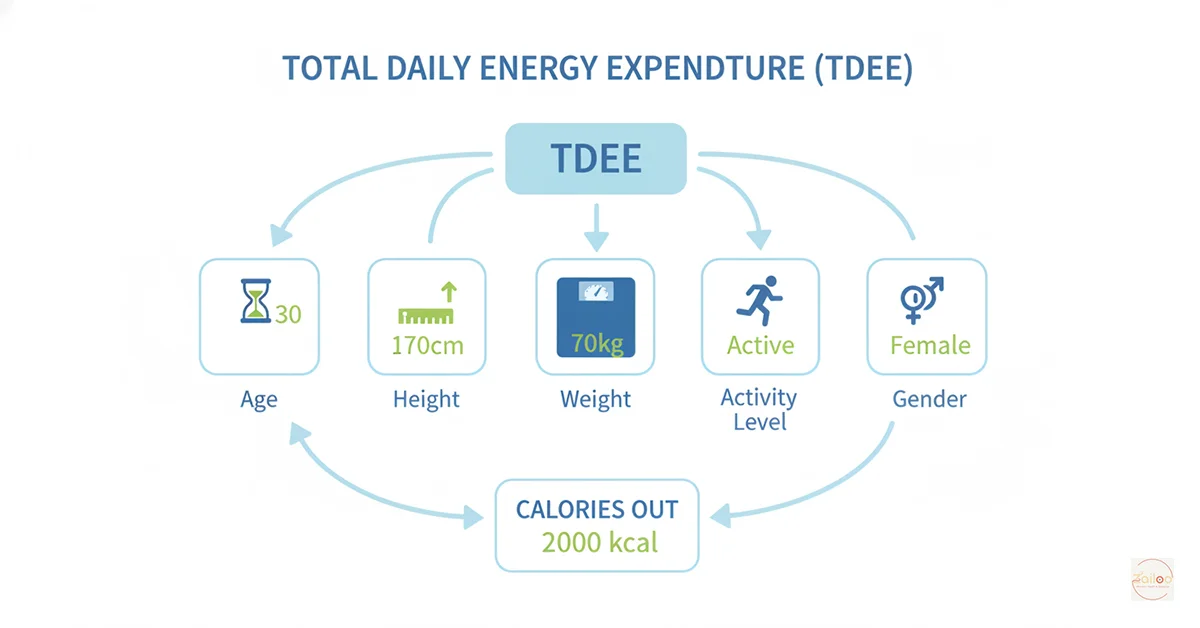
Your TDEE is influenced by several key factors:
- Age: Metabolism tends to slow down with age.
- Weight: Heavier bodies generally burn more calories.
- Height: Taller individuals typically have higher TDEEs.
- Activity Level: How much you move throughout the day (from sedentary to very active).
- Gender: Women generally have lower TDEEs than men due to differences in body composition.
While you can use complex formulas like the Mifflin-St Jeor Equation, the easiest and most accurate way for most women to find their TDEE is by using a reliable online calculator.
We highly recommend using our dedicated TDEE Calculator, which takes all these factors into account to give you a precise estimate tailored to you.

Step 2: Determine Your Ideal Calorie Deficit for Women
Once you know your TDEE, the next step is to decide how large your calorie deficit should be. A common guideline for losing 1 to 2 pounds per week is to create a deficit of 500 to 1000 calories per day. This is because approximately 3,500 calories equals one pound of fat. So, a 500-calorie daily deficit would theoretically lead to a 1-pound weight loss per week (500 calories/day x 7 days/week = 3,500 calories/week).
However, for women, it’s crucial to approach this with caution. While a 500-calorie deficit is generally a good starting point, going too aggressive can be detrimental to your metabolism and hormonal balance. We generally recommend aiming for a safe range of 250-500 calories below your TDEE for sustainable results. This allows for steady, healthy progress without shocking your system.
The Dangers of Too Large a Deficit
Cutting too many calories might seem like a fast track to weight loss, but it can backfire, especially for women. An excessively large calorie deficit can lead to:
- Metabolic Slowdown: Your body adapts to severe calorie restriction by lowering its metabolism to conserve energy, making further weight loss harder. This is a well-documented phenomenon known as metabolic adaptation. According to a study published by the NIH, sustained calorie restriction can significantly lower resting metabolic rate.
- Nutrient Deficiencies: It becomes challenging to get all the essential vitamins and minerals your body needs from very few calories.
- Fatigue and Low Energy: Insufficient calories mean less energy for daily activities and exercise.
- Hormonal Imbalances: For women, severe restriction can disrupt menstrual cycles, affect fertility, and impact mood.
- Muscle Loss: Your body might start breaking down muscle tissue for energy instead of just fat, which is counterproductive for metabolism.
Step 3: Track Your Calorie Intake Accurately
Calculating your deficit is only half the battle; the other half is consistently adhering to it. Accurate tracking of your food intake is paramount to ensure you’re staying within your target calorie range.
Tips for Accurate Tracking
- Use an App or Journal: Many excellent calorie-tracking apps (like MyFitnessPal, Lose It!) make logging food easy. A simple food diary can also be effective.
- Weigh Your Food: While measuring cups are helpful, weighing your food with a kitchen scale provides the most accurate calorie count, especially for things like grains, nuts, and proteins.
- Account for Everything: Don’t forget cooking oils, sauces, dressings, snacks, and even caloric beverages. Every calorie counts.
- Be Consistent: Try to log your food immediately after you eat it to avoid forgetting. Consistency leads to better results.
To help you put all these numbers together and visualize your daily target, our Calorie Deficit Calculator can be an invaluable tool, providing you with a clear daily calorie goal to aim for.
Fueling Your Body: Smart Food Choices on a Calorie Deficit
A calorie deficit doesn’t mean starvation; it means strategic eating. Focus on nutrient-dense foods that keep you full and energized, rather than empty calories.
Prioritize Protein & Fiber
These two macronutrients are your best friends on a calorie deficit:
- Protein: Keeps you feeling full longer, helps preserve muscle mass during weight loss, and has a higher thermic effect (meaning your body burns more calories digesting it). Aim for a lean protein source at every meal. Research suggests protein intake significantly impacts satiety.
- Fiber: Found in fruits, vegetables, and whole grains, fiber adds bulk to your meals without many calories, promoting fullness and digestive health.
Examples: Lean meats (chicken, turkey, fish), eggs, Greek yogurt, legumes (beans, lentils), plenty of colorful vegetables, and whole grains like quinoa or oats.
Don’t Fear Healthy Fats
While fats are calorie-dense, healthy fats are crucial for hormone production, nutrient absorption, and satiety. Just be mindful of portion sizes. A little goes a long way!
Examples: Avocados, nuts, seeds, olive oil, and fatty fish (like salmon).
Hydration is Key
Often, what we perceive as hunger is actually thirst. Drinking plenty of water throughout the day can help manage hunger pangs, boost metabolism slightly, and keep your body functioning optimally. Aim for at least 8 glasses of water daily.
Incorporating Movement: Beyond Just Burning Calories
While diet is paramount for a calorie deficit, exercise plays a vital supporting role. It not only burns calories but also helps build muscle, which is a metabolic powerhouse.
Strength Training for Women’s Metabolism
Don’t be afraid of weights! Building muscle is one of the most effective ways to boost your resting metabolism. Muscle tissue burns more calories at rest than fat tissue. This means a more efficient metabolism, even when you’re not actively exercising.
Practical Advice: Aim for 2-3 strength training sessions per week, targeting major muscle groups. You can use bodyweight exercises, free weights, or resistance bands. To understand how your metabolism might be affected by muscle mass, explore our Metabolism Calculator.
Cardio for Heart Health & Calorie Burn
Cardiovascular exercise, or cardio, is excellent for heart health, endurance, and burning calories during the activity. It complements strength training beautifully.
Suggested Types: Brisk walking, jogging, cycling, dancing, swimming, or even hiking. Find an activity you enjoy and aim for at least 150 minutes of moderate-intensity cardio per week.
Navigating Common Hurdles for Women on a Calorie Deficit
The weight loss journey isn’t always linear, especially for women. Understanding and preparing for common challenges can make a big difference.
Hormonal Fluctuations
Women’s bodies are uniquely susceptible to hormonal shifts that can impact weight, hunger, and energy levels. Menstrual cycles, perimenopause, and menopause can all affect your metabolism and appetite, making calorie deficit adherence more challenging during certain times of the month or life stages. Be patient and kind to your body during these periods.
Stress & Emotional Eating
Life can be stressful, and for many, food becomes a coping mechanism. Learning to distinguish between physical hunger and emotional hunger is crucial. Develop healthy stress-management techniques that don’t involve food, such as meditation, walking, talking to a friend, or pursuing a hobby.
Plateaus: What to Do When Weight Loss Stalls
It’s normal for weight loss to slow down or stop after initial progress. This is often called a plateau. When you hit one:
Consider a “Diet Break”: Sometimes, a short period (1-2 weeks) at maintenance calories can help “reset” your metabolism before resuming your deficit.
Re-evaluate Intake: Double-check your calorie tracking for accuracy. Are you unknowingly consuming more than you think?
Increase Activity: Try a new workout routine or increase the intensity/duration of your current one.

When to Consult a Professional
While this guide provides comprehensive information, it’s essential to recognize when professional guidance is needed. If you have underlying health conditions, take medications that affect weight, or are struggling to achieve results despite consistent effort, consulting a doctor or a registered dietitian is highly recommended. They can provide personalized advice tailored to your unique health profile and needs.
FAQs: Your Top Questions About Calorie Deficits Answered
Let’s address some of the most common questions women have about calorie deficits:
Q1: Is a 1200-calorie diet safe for all women?
A: Generally, no. A 1200-calorie diet is often too restrictive for most adult women and can lead to nutrient deficiencies, fatigue, and metabolic slowdown. While it might be prescribed by a doctor for very specific, short-term scenarios, it is not a sustainable or healthy long-term approach for the majority. Always aim for a deficit that allows adequate nutrition.
Q2: How quickly can I expect to lose weight on a calorie deficit?
A: A healthy and sustainable weight loss rate is typically 1 to 2 pounds per week. While you might see faster initial weight loss (often water weight), consistent loss at this rate is more likely to be fat and more likely to stay off. Patience and consistency are key.
Q3: Can I lose weight without strictly counting calories?
A: Yes, it’s possible! You can create a calorie deficit through mindful eating, focusing on whole, unprocessed foods, increasing protein and fiber intake, practicing portion control, and limiting sugary drinks and highly processed snacks. While you’re not explicitly counting, you’re still inherently creating a deficit through smarter choices. However, for precise control and understanding, counting can be very effective.
Q4: How does metabolism affect my calorie deficit needs?
A: Metabolism is your body’s process of converting food into energy. Individual metabolic rates vary, meaning some people naturally burn more calories than others. A faster metabolism means a higher TDEE, so you might be able to eat more while still being in a deficit. Conversely, a slower metabolism means your TDEE is lower, requiring a smaller calorie intake for a deficit. Building muscle through strength training is a great way to naturally boost your metabolism.
Q5: What if I’m constantly hungry on a calorie deficit?
A: Persistent hunger often indicates either your deficit is too large, or you’re not eating the right foods. Focus on increasing your intake of lean protein, high-fiber vegetables, and healthy fats. Ensure you’re drinking enough water. If hunger remains overwhelming, consider slightly reducing your deficit or consulting a professional to ensure your plan is sustainable.
Conclusion: Your Path to Sustainable Weight Loss
Creating a calorie deficit to lose weight doesn’t have to be daunting. By understanding your TDEE, calculating a safe and sustainable deficit, and making smart, informed food and exercise choices, you can achieve your weight loss goals. Remember, consistency, patience, and self-compassion are your most powerful tools. This isn’t just about numbers; it’s about building healthier habits that support your well-being for the long run. Take the first step today towards a healthier, happier you.
Disclaimer: This article provides general information and is not a substitute for professional medical advice. Always consult with a qualified healthcare provider or registered dietitian before making significant changes to your diet or exercise routine.
Ready to start your journey? Use our Calorie Deficit Calculator today and take control of your health!