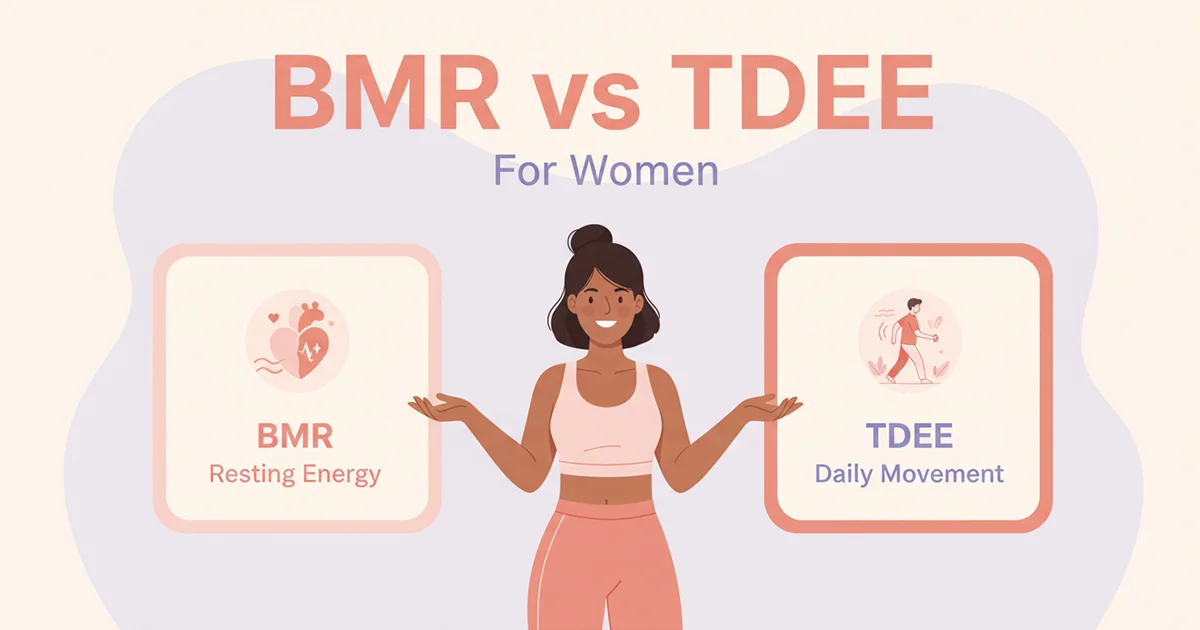
Navigating the world of calorie needs can feel overwhelming, especially with so much conflicting information out there. For women, understanding your body’s unique energy demands, specifically the difference between Basal Metabolic Rate (BMR) and Total Daily Energy Expenditure (TDEE), is key to informed health and weight planning.
Unraveling the Calorie Confusion for Women
If you’re a woman who has ever tried to understand your calorie needs for weight management, you’ve likely encountered a dizzying array of terms: BMR, TDEE, “resting calories,” “maintenance calories,” and countless different formulas and pieces of advice. It’s easy to feel lost in the noise, especially when social media and popular diet culture often oversimplify complex biological processes or promote unsustainable practices.
One of the most common points of confusion revolves around two specific metrics: Basal Metabolic Rate (BMR) and Total Daily Energy Expenditure (TDEE). Many women wonder if these are interchangeable, or which one they should focus on when planning their nutrition. Crucially, BMR and TDEE are not the same, and misunderstanding their distinct roles can lead to frustration, stalled progress, or even unintended negative health consequences.
This comprehensive guide is designed to cut through the confusion and provide a clear, science-backed explanation of BMR and TDEE, specifically tailored for women. We’ll explore what each term means, why they differ, and most importantly, which number you should truly be using as the foundation for your health and weight planning, all while prioritizing your well-being.
What is BMR? (Basal Metabolic Rate for Women)
Imagine your body as a high-tech machine, constantly running even when you’re completely at rest. Your Basal Metabolic Rate, or BMR, represents the minimum number of calories your body needs to perform these fundamental, life-sustaining functions. Think of it as the energy required to simply exist.
What BMR Includes
BMR accounts for the energy your body expends on vital involuntary processes. These include:
- Breathing: The constant work of your diaphragm and lungs.
- Circulation: Your heart tirelessly pumping blood throughout your body.
- Cell Production: The ongoing process of creating new cells and repairing old ones.
- Nutrient Processing: The energy used by your kidneys, liver, and other organs to process nutrients and eliminate waste.
- Maintaining Body Temperature: Keeping your internal temperature stable.
- Hormone Production: The energy expended by your endocrine system to regulate everything from mood to metabolism.
Essentially, your BMR is the energy your body would burn if you were to spend an entire day lying awake but completely motionless in a temperature-controlled environment, without eating or digesting anything. It’s the baseline energy cost of keeping you alive.
How BMR is Estimated
While BMR can be precisely measured in a lab setting under strict conditions (known as indirect calorimetry), it is more commonly estimated using predictive equations. Several formulas exist, such as the Mifflin-St Jeor equation and the Harris-Benedict equation, which take into account factors like age, gender, weight, and height to provide an approximate BMR. While these formulas don’t require complex math from you, it’s important to understand that they provide an estimate, not an exact measurement.
Why Women Generally Have Lower BMR Than Men
You might have noticed that general calorie recommendations often differ significantly between men and women. One primary reason for this is differences in BMR. On average, women tend to have a lower BMR than men. This is primarily due to two factors:
- Body Composition: Men generally have a higher percentage of lean muscle mass compared to women. Muscle tissue is metabolically more active than fat tissue, meaning it burns more calories at rest.
- Body Size: On average, men tend to be taller and heavier than women, which also contributes to a higher BMR, as larger bodies require more energy to maintain vital functions.
Understanding these physiological differences is crucial for women, as it means their baseline energy needs are inherently different and often lower than those of men. According to the National Institutes of Health (NIH) and Harvard Health Publishing, these fundamental biological distinctions are key to personalized nutrition.
What is TDEE? (Total Daily Energy Expenditure)
While BMR gives us a foundational understanding of your body’s absolute minimum energy needs, it doesn’t paint a complete picture of your daily calorie burn. That’s where Total Daily Energy Expenditure, or TDEE, comes in. TDEE is a much more practical and realistic number, representing the total number of calories your body burns throughout an entire day, taking into account all your activities, from sleeping to exercising.
Components of TDEE
TDEE is a comprehensive sum of four main components:
- Basal Metabolic Rate (BMR): This is the largest component, typically accounting for 60-75% of your total daily calorie burn. As we discussed, it’s the energy for your basic bodily functions.
- Thermic Effect of Activity (TEA) / Physical Activity: This includes all intentional exercise and movement, such as going for a run, hitting the gym, playing sports, or even just walking. This component is highly variable and depends on the intensity, duration, and type of your physical activity.
- Non-Exercise Activity Thermogenesis (NEAT): NEAT refers to the calories burned through all the movements you do that are NOT structured exercise. This includes fidgeting, standing, walking around the house, cooking, cleaning, gardening, taking the stairs, and even talking. NEAT can significantly contribute to your total calorie expenditure and often goes unnoticed.
- Thermic Effect of Food (TEF): Also known as diet-induced thermogenesis, TEF is the energy your body uses to digest, absorb, transport, and store the nutrients from the food you eat. Protein has the highest TEF, meaning your body burns more calories to process protein compared to carbohydrates or fats. TEF typically accounts for about 5-10% of your total calorie expenditure.
When you add up your BMR, physical activity, NEAT, and TEF, you get your Total Daily Energy Expenditure – the true number of calories your body burns in a day.
Why TDEE Reflects Real Life
Unlike BMR, which is a theoretical minimum, TDEE is a practical reflection of your actual energy needs. Very few women (or anyone) spend their entire day motionless in a controlled environment. We move, we work, we eat, we engage in hobbies, and all these activities require energy. TDEE accounts for this dynamic nature of daily life, providing a much more useful benchmark for understanding your calorie needs.
To get a personalized estimate of your TDEE, which is essential for any informed calorie planning, you can easily use an online tool. We highly recommend our accurate TDEE calculator for women to get started.
BMR vs TDEE. Key Differences for Women
Now that we’ve defined both terms, let’s explicitly highlight the critical distinctions between BMR and TDEE, particularly how they apply to women’s health and weight management.
- Purpose: BMR serves as a theoretical baseline – the absolute minimum calories needed for vital organ function when at complete rest. TDEE, on the other hand, is your practical, real-world energy expenditure, encompassing all movement and food digestion throughout an entire day.
- Practical Use: BMR is rarely the number you should use for daily calorie intake planning, as it excludes almost all daily activity. TDEE is the number you should primarily focus on when trying to understand how many calories you actually burn and how many you need to consume for maintenance, weight loss, or weight gain.
- Static vs. Dynamic: Your BMR is relatively static, changing slowly with age, significant changes in body composition, or hormonal shifts. Your TDEE is highly dynamic and fluctuates daily based on your activity levels. A day spent relaxing at home will result in a lower TDEE than a day filled with exercise, errands, and active work.
- Medical vs. Lifestyle Application: BMR is often used in clinical or research settings to understand metabolic function or in very specific medical scenarios (e.g., comatose patients). TDEE is the number that applies directly to your everyday lifestyle and nutrition choices.
In simple terms: your BMR is like the idle fuel consumption of your car, while your TDEE is the total fuel consumed during a road trip, including starting, stopping, accelerating, and driving at various speeds.
Why Many Women Make the Mistake of Eating at BMR
Despite the clear distinctions, a significant number of women, often inadvertently, attempt to eat at or even below their BMR in an effort to lose weight. This common mistake stems from a combination of misinformation, aggressive diet culture, and a fundamental misunderstanding of how the body uses energy.
Social Media Myths and Diet Culture Influence
The internet, particularly social media platforms, is rife with diet advice that is often oversimplified, misinformed, or even dangerous. You might see influencers promoting extremely low-calorie diets, often framed as “quick fixes” or “detoxes,” without any explanation of BMR, TDEE, or the long-term metabolic consequences. This often leads women to believe that if BMR is the lowest your body burns at rest, eating at that level (or less) will automatically lead to rapid fat loss.
Diet culture has historically emphasized restriction and deprivation, often suggesting that “less is always more” when it comes to calories. This narrative can be incredibly powerful and lead women to ignore their body’s hunger cues and actual energy needs in pursuit of an unrealistic or unhealthy ideal.
Why Eating at BMR Can Be Harmful
Consistently eating at or below your BMR can have serious and detrimental effects on a woman’s body and overall health. Remember, your BMR is the energy required just for basic survival functions. When you consume calories below this essential baseline, your body interprets this as a state of starvation. This can trigger a cascade of negative adaptations, including:
- Metabolic Slowdown: Your body, in an attempt to conserve energy, may slow down its metabolism, making it harder to lose weight in the long run. This is a survival mechanism.
- Nutrient Deficiencies: Eating too few calories makes it difficult to consume adequate vitamins, minerals, and macronutrients, leading to deficiencies that can impact everything from bone health to immune function.
- Hormonal Imbalances: For women, severe calorie restriction can disrupt the delicate balance of hormones, leading to irregular periods, fertility issues, and impact mood and energy levels. The Endocrine Society consistently highlights the critical role of adequate energy intake for healthy hormone function.
- Loss of Muscle Mass: When calorie intake is too low, your body may start breaking down muscle tissue for energy, further lowering your BMR and hindering fat loss efforts.
- Fatigue and Reduced Physical Performance: Insufficient energy intake leaves you feeling tired, irritable, and unable to perform well during exercise or daily activities.
- Increased Risk of Disordered Eating: Chronic restriction can often lead to a preoccupation with food, binge-eating cycles, and the development of unhealthy relationships with food.
As the Cleveland Clinic emphasizes, prioritizing adequate nutrition and avoiding extreme restriction is vital for sustainable health and metabolic well-being. Eating at your BMR is a recipe for an undernourished, unhappy body, not a healthy weight loss journey.
Which Number Should Women Use for Weight Loss?
The answer is unequivocally: TDEE.
When it comes to planning your calorie intake for weight loss, maintenance, or even weight gain, your Total Daily Energy Expenditure (TDEE) is the number you should always start with. Your TDEE represents the actual number of calories your body burns in a day, accounting for your unique activity level and metabolic processes.
Why a Deficit is Applied AFTER TDEE
To lose weight, you need to create a calorie deficit, meaning you consume fewer calories than your body burns. This deficit should be created in relation to your TDEE, not your BMR. Here’s why:
- Accurate Baseline: Your TDEE provides a realistic estimate of your body’s total energy needs. It factors in your daily movements, exercise, and digestion, giving you a true “maintenance” number.
- Sustainable Deficit: When you reduce calories from your TDEE, you’re creating a deficit that is more likely to be manageable and sustainable. A moderate deficit (typically 300-500 calories below TDEE for gradual weight loss) allows you to still eat enough to fuel your body, maintain energy levels, and get adequate nutrients.
- Preserves Health: By subtracting from your TDEE, you ensure that you’re still consuming enough calories to support your basal metabolic functions and daily activities, avoiding the negative health consequences associated with eating below your BMR.
Think of it this way: if your TDEE is 2000 calories, and you aim for a 500-calorie deficit, you would target 1500 calories per day. If your BMR was, for example, 1300 calories, then eating 1500 calories is still well above your BMR, ensuring your body has enough energy for its essential functions.
To help you determine a safe and effective calorie target for weight loss, we recommend using a reliable tool. Our calorie deficit calculator for women can help you find a suitable deficit based on your estimated TDEE and goals.
Important Safety Note: While a calorie deficit is necessary for weight loss, it’s crucial that this deficit is safe and sustainable. Always prioritize your health over rapid weight loss. Consult with a healthcare professional or registered dietitian for personalized advice, especially if you have underlying health conditions.
Real-Life Example: Sarah’s Calorie Journey
Let’s consider a hypothetical woman, Sarah, a 35-year-old marketing professional who weighs 160 lbs and is 5’5″ tall. She works a desk job but enjoys walking her dog for 30 minutes daily and goes to a yoga class three times a week.
Comparing BMR vs. TDEE Numbers
Using standard estimation formulas, Sarah’s numbers might look something like this:
- Sarah’s Estimated BMR: Approximately 1450 calories
- Sarah’s Estimated TDEE: Approximately 2100 calories (factoring in her light-to-moderate activity level)
Notice the significant difference! Her TDEE is 650 calories higher than her BMR. This 650-calorie difference represents the energy she burns just by existing in the world, moving around, digesting food, and doing her regular activities.
How Eating at BMR Feels vs. TDEE-Based Deficit
Let’s imagine two scenarios for Sarah:
Scenario 1: Eating at BMR (1450 calories)
If Sarah were to try and eat only 1450 calories per day (her BMR), she would be significantly under-fueling her body. She would likely feel:
- Constantly hungry: Her body would be signalling a severe energy deficit.
- Fatigued: Lacking the energy for her daily dog walks, yoga, and even her desk job.
- Irritable and mentally foggy: Her brain wouldn’t be getting adequate fuel.
- Struggling with workouts: Her yoga performance would suffer, and she’d likely have trouble recovering.
- Potential nutrient deficiencies: It would be very challenging to meet all her micronutrient needs on such low calories.
This approach is unsustainable and potentially harmful, leading to metabolic slowdown and likely rebound weight gain.
Scenario 2: Eating with a TDEE-Based Deficit (e.g., 1700-1800 calories)
If Sarah uses her TDEE (2100 calories) as her baseline and aims for a moderate 300-400 calorie deficit, she would target an intake of 1700-1800 calories per day. On this intake, she would:
- Feel more satiated: While still in a deficit, she’d be eating enough to manage hunger effectively.
- Have sufficient energy: She could maintain her dog walks, enjoy her yoga classes, and stay focused at work.
- Get adequate nutrients: It would be much easier to build balanced meals that provide essential vitamins and minerals.
- Experience gradual, sustainable weight loss: This deficit would allow her body to slowly tap into fat stores without feeling deprived or triggering extreme metabolic adaptations.
This example clearly illustrates why TDEE is the practical number for guiding your calorie intake. It allows for effective progress while supporting your overall health and well-being.
Special Considerations for Women
While the principles of BMR and TDEE apply universally, women face unique physiological factors and life stages that warrant special attention when considering their energy needs.
9.1 Underweight Women
CRITICAL SAFETY WARNING: If you are underweight (BMI below 18.5) or suspect you might be, pursuing weight loss can be extremely dangerous and is strongly discouraged. This article’s advice on calorie deficits is NOT for you. Please seek guidance from a healthcare professional or a registered dietitian immediately. Their expertise is essential to ensure your health and safety.
For underweight women, the focus should be on healthy weight gain and nutritional rehabilitation, not calorie restriction. Eating below your BMR or even at a TDEE-based deficit can exacerbate health issues such as:
- Osteoporosis risk
- Hormonal disruptions (e.g., amenorrhea, infertility)
- Weakened immune system
- Cardiovascular problems
- Severe fatigue and organ dysfunction
Your primary goal should be to consume adequate calories to support your body’s functions and reach a healthy weight range. Your BMR provides the absolute minimum your body needs; your TDEE for weight gain would involve eating above your maintenance calories.
9.2 Perimenopause & Menopause
The transition into perimenopause and menopause brings significant hormonal shifts that can impact a woman’s metabolism. Estrogen levels fluctuate and eventually decline, which can lead to:
- Metabolic Shifts: Some women experience a slight decrease in BMR due to changes in body composition (e.g., loss of lean muscle mass) and hormonal regulation.
- Fat Redistribution: There’s often a shift in fat storage towards the abdominal area, even without significant weight gain.
- Energy Fluctuations: Hot flashes, sleep disturbances, and mood changes can affect activity levels and perceived energy needs.
During this phase, it’s particularly important to avoid extreme dieting. Restrictive eating can worsen symptoms, contribute to bone density loss, and make it harder to manage weight in a healthy way. Focusing on nutrient-dense foods, adequate protein, strength training to preserve muscle mass, and adjusting TDEE estimates to reflect any changes in activity and BMR are key. The Endocrine Society provides valuable resources on managing health during menopause.
9.3 Highly Active Women
For women who engage in intense or prolonged physical activity (e.g., endurance athletes, professional dancers, women with physically demanding jobs), ensuring adequate calorie intake is paramount. While their TDEE will be significantly higher than sedentary women, there’s also a higher risk of under-fueling, known as “low energy availability.”
Low energy availability (LEA) occurs when a woman’s energy intake is insufficient to cover the energy expended through exercise and the demands of basic physiological functions. This is not just about feeling tired; chronic LEA can lead to a condition known as Relative Energy Deficiency in Sport (RED-S), which has severe health consequences, including:
- Menstrual dysfunction (loss of periods)
- Decreased bone density and increased fracture risk
- Impaired immune function
- Reduced metabolic rate
- Increased risk of injury
- Poor cardiovascular health
- Psychological distress
The International Olympic Committee (IOC) has extensively researched RED-S, emphasizing the importance of proper fueling for active individuals. Highly active women should work closely with a sports dietitian or healthcare provider to accurately estimate their TDEE and ensure their calorie intake adequately supports both their activity levels and their essential physiological processes.
Common Myths About BMR & TDEE
Let’s debunk some persistent myths that often confuse women on their health journeys:
Myth 1: “Lower BMR means I can’t lose weight.”
Correction: While a lower BMR means fewer calories burned at rest, it absolutely does not prevent weight loss. It simply means your starting point for calorie expenditure is different. Weight loss still depends on creating a calorie deficit relative to your TDEE. Focus on increasing your activity level (which boosts TDEE) and making sustainable dietary changes rather than fixating on your BMR as a limiting factor.
Myth 2: “Eating below BMR burns fat faster.”
Correction: This is a dangerous misconception. As discussed, eating below your BMR triggers survival mechanisms that slow your metabolism, break down muscle, and can lead to nutrient deficiencies and hormonal issues. While you might see initial rapid weight loss (often water and muscle), it’s unsustainable, unhealthy, and often leads to rebound weight gain and a harder time losing weight in the future. Sustainable fat loss occurs with a moderate deficit below your TDEE, not your BMR.
Myth 3: “TDEE calculators are useless because they’re just estimates.”
Correction: While it’s true that TDEE calculators provide estimates and not precise measurements, they are incredibly valuable starting points. Direct measurement of TDEE is complex and costly (e.g., using doubly labeled water). For the average person, a well-designed online calculator, using established formulas and asking for accurate activity levels, provides a very good approximation. The key is to use it as a starting point and then monitor your progress and adjust your intake based on how your body responds over time. They are far from useless; they are empowering tools for informed planning.
How Women Should Use BMR & TDEE Together
While TDEE is your primary number for calorie planning, understanding your BMR still holds value. Here’s how women can intelligently use both concepts in their health journey:
BMR = Understanding Your Baseline: Your BMR gives you insight into your body’s most fundamental energy requirements. It’s a reminder of the non-negotiable energy needed for your organs to function, even if you do nothing all day. Knowing your BMR can help you understand the lower limits of what your body needs and reinforces why eating below it is not advisable. It helps you appreciate your body’s constant internal work.
TDEE = Planning Your Intake: This is where the practical application truly shines. Your TDEE is the dynamic number that guides your daily calorie intake for your specific goals. Want to maintain weight? Eat at your TDEE. Want to gain weight? Eat above your TDEE. Want to lose weight? Create a safe, moderate deficit below your TDEE. It’s the actionable number that reflects your actual lifestyle.
Deficit = Optional, Conditional, Health-First: Creating a calorie deficit is a tool for weight loss, but it’s not always necessary or appropriate for every woman. If you choose to pursue a deficit, always apply it to your TDEE, not your BMR. Ensure the deficit is moderate (typically 300-500 calories below TDEE) to promote sustainable fat loss while preserving muscle mass and metabolic health. Always prioritize a safe calorie deficit that supports your energy levels and overall well-being.
Monitoring and Adjustment: No calculator is perfect, and every woman’s body is unique. Use your calculated TDEE as a starting point. Then, consistently monitor your progress (weight, measurements, energy levels, mood) over several weeks. If you’re not seeing the desired results, or if you feel consistently low on energy, adjust your intake or activity levels slightly. This iterative process, guided by data and how you feel, is far more effective than blindly following a single number.
For more detailed information, consider revisiting articles such as “How Many Calories Should a Woman Eat to Lose Weight?” and “What Is TDEE and Why It Matters for Women” and “Calorie Deficit Explained for Women” for deeper insights into these interconnected topics.
Frequently Asked Questions About BMR & TDEE for Women
Q: Is BMR the minimum calories a woman should eat?
A: Your BMR represents the absolute minimum calories your body needs to survive at rest. In practical terms, no woman should regularly eat at or below her BMR. Your body needs additional calories for daily activities, digestion, and movement. Eating at your BMR is akin to under-fueling a car that still needs to drive.
Q: Should women ever eat below BMR?
A: No, under almost all normal circumstances, women should never intentionally eat below their BMR. Doing so can lead to severe metabolic slowdown, muscle loss, nutrient deficiencies, hormonal imbalances, and other serious health issues. If you’re struggling with eating habits, please consult a healthcare professional.
Q: Can TDEE change?
A: Yes, absolutely! Your TDEE is dynamic. It changes based on your activity level (exercise, NEAT), body weight (as you lose or gain), and even your body composition (more muscle mass means higher TDEE). As you change, your TDEE will change, which is why periodic re-evaluation is helpful.
Q: Does age lower metabolism a lot?
A: Age does tend to slightly lower BMR, primarily due to natural changes in body composition (a gradual loss of muscle mass) and hormonal shifts. However, the impact is often less dramatic than widely believed. Staying active and continuing strength training can significantly mitigate age-related metabolic decline. It’s not an insurmountable barrier to managing your weight.
Q: Are TDEE calculators accurate?
A: TDEE calculators use scientific formulas to provide a strong estimate, but they are not 100% precise measurements. They serve as excellent starting points. The most accurate TDEE for you is ultimately found by consistently tracking your intake and monitoring your body’s response over several weeks, then making small adjustments as needed.
Q: Is low BMR bad?
A: A lower BMR is simply a reflection of your individual physiology (e.g., body size, body composition). It’s not inherently “bad.” It just means your baseline energy needs are lower compared to someone with a higher BMR. The important thing is to understand your unique BMR and use your TDEE as the guide for your actual calorie intake, ensuring you meet your body’s needs.
Conclusion & Final Call to Action
Navigating the nuances of metabolism and calorie planning can feel complex, but understanding the fundamental difference between BMR and TDEE is a powerful step towards informed health decisions for women. Remember, your BMR is the energy required for basic survival, a non-negotiable minimum.
BMR is not a diet number. TDEE is the foundation.
Your Total Daily Energy Expenditure (TDEE) is the practical number that truly reflects your body’s daily calorie burn, encompassing your unique activities and lifestyle. It is the number you should use as the cornerstone for planning your nutrition, whether your goal is maintenance, healthy weight loss, or weight gain.
By focusing on your TDEE and applying any calorie deficits in a safe, moderate, and sustainable way, you empower yourself to achieve your health goals without compromising your well-being. Prioritizing your body’s needs, listening to its signals, and making informed choices based on scientific understanding will lead to much more positive and lasting results.
Ready to put this knowledge into practice?
Disclaimer: The information provided in this article is for educational purposes only and is not intended as medical advice. Always consult with a qualified healthcare professional or registered dietitian before making any significant changes to your diet or exercise routine, especially if you have existing health conditions.